
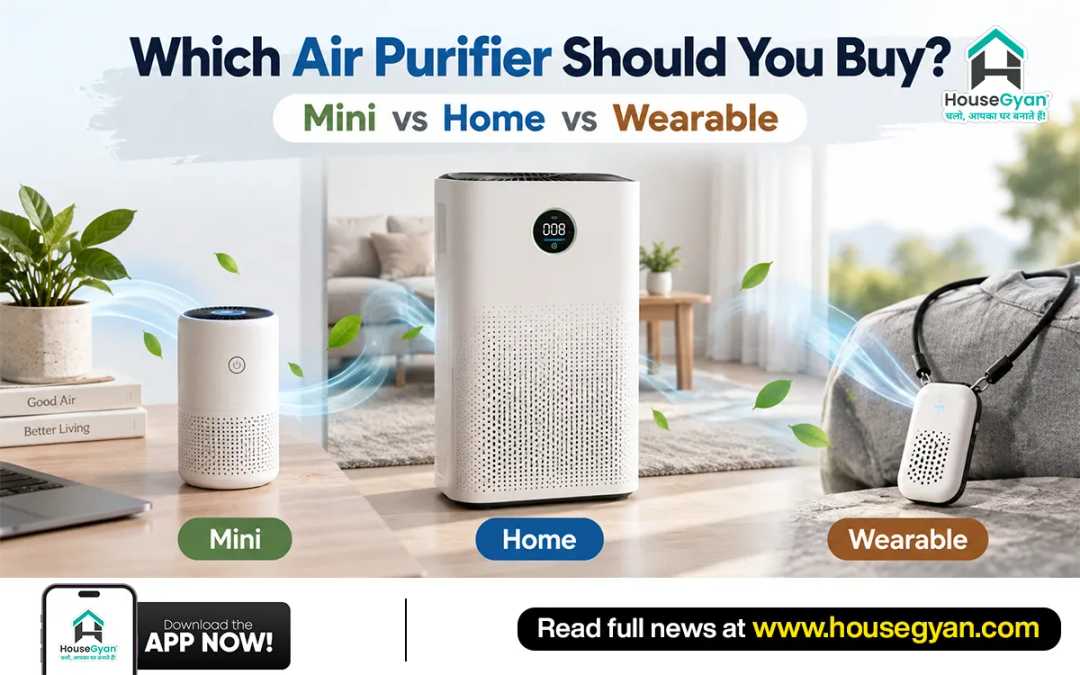
Air purifiers are available in different sizes and designs, from compact mini models to full-size home air purifiers and wearable devices designed to stay close to your breathing zone. Choosing between them depends on where you want to use the purifier, the size of the area and the type of air pollution you want to address.
A mini air purifier can be useful for small personal spaces, a home air purifier is designed to clean the air in a room, while a wearable air purifier is designed for personal use when moving between different locations. Portable air cleaners can help reduce indoor particle pollution, but no purifier removes every pollutant.
Mini vs Home vs Wearable Air Purifier
1. Mini Air Purifier: Best for Small Personal Spaces
Mini air purifiers are compact models designed for relatively small areas. They can be placed on a bedside table, work desk, study table, small office space or other limited areas.
Some compact models use a combination of a pre-filter, particle filter and activated carbon filter. For example, the Levoit Core Mini-P uses a three-stage filtration system and is designed for very small spaces such as bathrooms, nurseries, dorm rooms and home offices.
When Should You Buy a Mini Air Purifier?
A mini purifier can make sense if:
You spend several hours at a desk.
You want a compact purifier for a small bedroom.
You have limited space for a larger appliance.
You want to move the purifier between small spaces.
You prefer a smaller and potentially quieter appliance.
However, don't assume that a smaller purifier can clean a large room effectively. Check its stated coverage and CADR before buying.
Also Read: Top 10 Air Purifier Brands in India
2. Home Air Purifier: Best for Room-Level Air Cleaning
Home or room air purifiers are designed to circulate and filter air throughout a room. For particle pollution, CADR (Clean Air Delivery Rate) is an important specification because a higher CADR generally means the purifier can filter more particles and serve a larger area.
HEPA filtration is commonly used in room air purifiers for capturing airborne particles. Activated carbon can be useful when odours and certain gaseous pollutants are a concern.
When Should You Buy a Home Air Purifier?
Choose a room purifier if:
You want to improve air quality in a bedroom or living room.
Your main concern is indoor dust or fine particles.
You spend most of your time indoors.
You want continuous air cleaning rather than personal-use purification.
You need a purifier with a measurable room coverage specification.
Check CADR Before Room Coverage Claims
Instead of choosing a purifier only because the packaging says it is suitable for a certain room size, compare its CADR with your room requirements. EPA guidance notes that higher CADR allows a portable air cleaner to filter more particles and serve a larger area.
3. Wearable Air Purifier: Designed for Personal Use
Wearable air purifiers are small devices that can be worn around the neck or carried while travelling. Their purpose is different from a room purifier: they aim to affect the air immediately around the user rather than clean an entire room.
Some wearable models use ionisation rather than conventional HEPA filtration. Their performance can be affected considerably by airflow and outdoor conditions. A 2026 Digit review notes that wearable ionisation devices are more suited to relatively still, enclosed environments and are not substitutes for N95 masks in heavy-smog conditions.
When Should You Consider a Wearable Air Purifier?
A wearable model may be considered if:
You need something extremely portable.
You frequently move between locations.
You spend time in offices, classrooms or vehicles.
You want a personal device rather than a room appliance.
Portability is more important to you than whole-room cleaning.
Important Limitation
A wearable purifier should not be treated as equivalent to a room HEPA purifier. Independent testing of wearable negative-ion products has also found limited particle-removal performance under controlled conditions.
Mini vs Home vs Wearable: Which One Fits Your Use?
For a Bedroom
A home/room air purifier is generally the more appropriate category because it is designed to circulate and filter room air. Look for suitable CADR, filter type, noise level and replacement-filter availability.
For a Work Desk
A mini air purifier may be more practical if you primarily want a compact device near your workspace. Check its actual coverage rather than assuming that its small size makes it suitable for the entire room.
For Travel
A wearable purifier offers the greatest portability. However, its operating technology and real-world effectiveness should be checked carefully before purchase.
For a Living Room
A home air purifier is generally the relevant category. A larger room requires an appropriately sized purifier with sufficient CADR.
For Outdoor Pollution
Neither a mini room purifier nor a wearable device should be treated as a replacement for appropriate personal protective measures in heavy pollution. Wearable ionisation devices can be particularly affected by moving air.
What Should You Check Before Buying an Air Purifier?
1. CADR
For room air purifiers, CADR is one of the most useful specifications for understanding particle-cleaning capacity. Higher CADR generally means more air can be cleaned in a given period.
2. Filter Type
Check whether the purifier uses a particle filter, HEPA filter, activated carbon or a combination. Particle filtration and gas/odour filtration are different functions.
3. Room Size
Always compare the manufacturer's recommended coverage with the room where you plan to use the purifier.
4. Filter Replacement
Filters become loaded over time and need regular replacement. A purifier's running cost therefore includes replacement filters, not just the initial purchase price.
5. Noise Level
If you plan to use the purifier while sleeping or working, check its noise specifications and whether it has a sleep or low-speed mode.
6. Power and Portability
Mini models and wearable devices may be easier to move, while larger home purifiers generally prioritise airflow and room coverage.
Which Air Purifier Should You Buy?
There isn't one type that suits every situation. Your choice should depend on where you want to use it and how much air you need to clean.
Choose a Mini Air Purifier for a compact personal space such as a desk or small room.
Choose a Home Air Purifier when your goal is room-level air cleaning.
Choose a Wearable Air Purifier when portability and personal use are the main priorities, while keeping its limitations in mind.
For most room-level air-cleaning needs, focus on measurable specifications such as CADR, filter type, room coverage and replacement-filter cost rather than choosing solely by size or appearance. Portable filtration works best as one part of indoor-air-quality management alongside reducing pollution sources and maintaining appropriate ventilation.
Conclusion
Mini, home and wearable air purifiers are designed for different situations. A mini model can be convenient for small personal spaces, a home purifier is intended for cleaning room air, and a wearable model focuses on the user's immediate breathing zone.
Before buying, consider your room size, pollution concerns, usage location, CADR, filtration technology, noise level and filter replacement requirements. This will help you select an air purifier that matches your actual needs instead of simply choosing the smallest, largest or most portable option.