
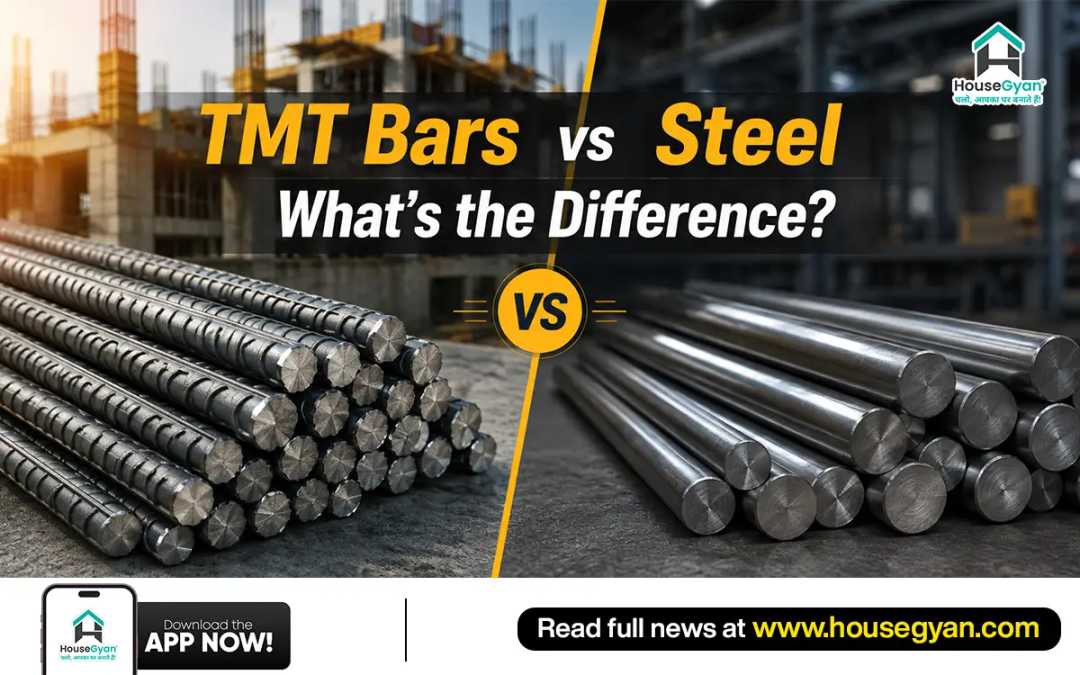
Steel is a material of paramount importance in the construction materials in modern building construction. But not all steels are used for similar purposes. It is a common phenomenon that many people compare TMT bars vs steel and which is more advantageous for residential construction. In common steel, They are mainly used for fabrication, structural frames, and industrial purposes, but TMT steel bars are specifically created for RCC construction, providing higher strength as well as durability.
What Are TMT Bars?
TMT bars (Thermo Mechanically Treated Bars) are high tensile strength reinforcement bars produced through a special process known as heat treatment. They are also employed for covering as reinforcement in the structure of Rendered Cement Concrete (RCC), due to their properties of strength, flexibility and corrosion resistance.
How TMT Bars Are Manufactured
To manufacture thermo mechanically treated bars, manufacturers run hot steel through the rapid water-cooling process followed by self-tempering. This forms a tough, flexible interior with a firm exterior and consequently renders these bars stronger than traditional steel.
Key Features of TMT Bars
-
High tensile strength
-
High degree of bending and stretching.
-
Superior corrosion resistance
-
High earthquake resistance
-
Better fire resistance
-
Easy weldability
-
Long service life with low maintenance
Common Applications of TMT Bars
-
Residential buildings
-
High-rise apartments
-
Bridges
-
RCC foundations
-
Columns and beams
-
Dams and flyovers
-
Industrial buildings
Read More: Top 10 Best TMT Bar Manufacturers in India.
What Is Steel?
Steel is an alloy that is composed of mainly iron and carbon. One of the most versatile types of construction materials, it is used widely in fabrication, machinery, structural frames, infrastructure projects, etc. By contrast, conventional steel is not thermo-mechanically treated, like TMT bars.
Types of Steel Used in Construction
-
Mild Steel (MS)
-
Carbon Steel
-
Structural Steel
-
Stainless Steel
-
Alloy Steel
Properties of Conventional Steel
-
Good strength
-
Easy to fabricate
-
Useful for structural elements
-
Lower ductility than TMT bars
-
More susceptible to corrosion when not protected
Common Applications of Steel
-
Structural frames
-
Roofing structures
-
Industrial sheds
-
Fabrication work
-
Machinery
-
Gates and railings
-
Warehouses
Read More: Top 10 Best Steel Companies in India 2026.
TMT Bars vs Steel: Comparison Table
Key Differences Between TMT Bars and Steel
1. Manufacturing Process
The largest difference between TMT and conventional manufacturing is in the case of manufacturing of TMT bars. In heat treatment, thermo mechanically treated bars are subjected to a controlled heat treatment process, whereas conventional steel does not require this as a process.
2. Tensile Strength
As high tensile steel, TMT steel bars are suitable for heavy load bearing structures and RCC construction.
3. Flexibility and Ductility
Due to heavy load or seismic forces, TMT bars will bend but not break. The conventional steel is less flexible in comparison.
4. Corrosion Resistance
Slower rusting occurs due to the hardened outer layer of TMT bars, which makes them ideal for coastal and humid locations.
5. Fire Resistance
TMT bars are also safe in fire, as they can withstand the high heat and do not lose their structural strength.
6. Earthquake Performance
A major advantage of the TMT vs steel is earthquake resistance. TMT bars are more ductile, which helps in absorbing seismic shocks and minimizing structural damages
7. Cost Comparison
TMT bars may be a little more expensive to buy than regular steel, but because of their superior longevity and maintenance needs, they prove to be more economical in the long run.
Read More: घर के लिए कौन सा TMT सरिया चुनें? खरीदने से पहले जानें ये बातें
Which One Should You Choose for House Construction?
-
RCC Foundations - In RCC house construction, the preferred choice TMT for RCC foundations gives good strength to the house and has excellent stability.
-
Columns and Beams - The structure's load is transferred through columns and beams, TMT bars have a higher load-leveling capacity and durability than traditional steel.
-
Slabs - Good steel reinforcement is necessary for roof and floor slabs. For enhanced crack resistance and better structural safety, TMT bars are responsible.
-
Industrial Structures - In the situations where RCC reinforcement is not necessary, conventional steel is used for the industrial sheds or for fabrication work or for structural frames.
-
Renovation Projects - TMT bars are used for RCC extensions or structural strengthening walls, as they tend to bond with RCC better and are more durable.
Common Mistakes to Avoid
-
Buying Non-Certified TMT Bars - Buy only BIS certified TMT steel bars from reputed manufacturers for guaranteed quality and safety.
-
Choosing the Wrong Grade - Use the proper grade, e.g Fe 500 or Fe 550, as recommended by your structural engineer.
-
Ignoring Corrosion Protection - Corrosion-resistant TMT bars too should be stored appropriately and protected from long-term exposure before use.
-
Focusing Only on Price - Lower quality materials could mean higher in-service and maintenance expenses. Always consider quality, strength, and durability.
-
Improper Storage at the Construction Site - To prevent rust during storage, keep reinforcement bars above ground and shield from moisture.
Conclusion
The choice between TMT bars vs steel depends on the application at hand. Steel bars made from steel with conventional quality are suitable for fabrication, machinery, structural frameworks and for TMT steel, it is particularly appropriate for RCC construction. They are the best reinforcement bars for use in houses due to their strength, flexibility, ability to resist corrosion, and earthquake resistance.
When it comes to which is better, TMT bars or steel, TMT bars for house construction, TMT bars are definitely the preferred option for house construction, foundations, beams, columns and slabs. The comparison guide reveals that the investment in high quality thermo mechanically treated bars is always a safer, stronger and durable construction.
Why HouseGyan?
HouseGyan empowers homeowners, builders, and property buyers to make informed decisions regarding construction steel by providing expert advice and guides.
From construction materials and house plans to cost estimation, Vastu guidance, and home maintenance tips, HouseGyan provides reliable information to help you build durable and cost-effective homes.
FAQs
1. What is the difference between TMT bars and conventional steel?
The key difference between TMT and conventional steel bars is that TMT bars have a higher strength, greater flexibility, and are more resistant to corrosion due to the thermo-mechanical treatment.
2. Why are TMT bars preferred for RCC construction?
The TMT bars are suitable for RCC Construction because of its high tensile strength, good steel reinforcement, superior ability to bond with concrete, and high earthquake resistance.
3. Are TMT bars stronger than ordinary steel?
Yes. TMT steel bars are stronger, more durable and more ductile than regular steel.
4. Which grade of TMT bar is best for house construction?
Based on the structural requirements, Fe 500 and Fe 550 are the most popular TMT bar grades used in house building.
5. Are TMT bars resistant to corrosion and earthquakes?
Yes. Quality thermo mechanically treated bars have outstanding performance in relation to corrosion, fire and earthquakes.
6. Can conventional steel replace TMT bars in residential construction?
No because, conventional steel is not as strong, ductile and durable as TMT bars, which are necessary for the structure of RCC.