
Table Of Content ☰
- 1. Introduction
- 2. What is a Slab in Construction?
- 3. What Is a One Way Slab? Uses, Pros, and Cons
- 4. What Is a Two Way Slab? Uses, Pros, and Cons
- 5. One Way Slab vs Two Way Slab: Key Differences
- 6. Reinforcement Details in One Way and Two Way Slab
- 7. Load Distribution in One Way and Two Way Slab
- 8. How to Identify One Way and Two Way Slab
- 9. Which Slab is Better for House Construction?
- 10. Cost Difference Between One Way and Two Way Slab
- 11. Common Mistakes to Avoid
- 12. Conclusion
- 13. Why HouseGyan?
- 14. FAQs
Introduction
Slabs are significant structural elements of building houses since they constitute the roof or floor and support the load securely. A lot of people confuse between one way slab and two way slab, however, it is not that difficult, it all depends on the way slab is bent and supports load. This guide describes what is one way slab, what is two way slab, the one way slab vs two way slab with example, and how to select the appropriate slab to lay on your home, especially while planning your house plan.
What is a Slab in Construction?
A slab is a horizontal concrete structural surface which can be used as a floor or roof. It is one of the slab types in construction that supports the weight of people, furniture, walls, and finishes to the beams or walls. In the RCC slab design basics, the engineers are required to determine the thickness, span, reinforcement, and support of slabs depending on the size of the building and its purpose. The one way slab and two way slab are the most common types of slabs.
What Is a One Way Slab? Uses, Pros, and Cons
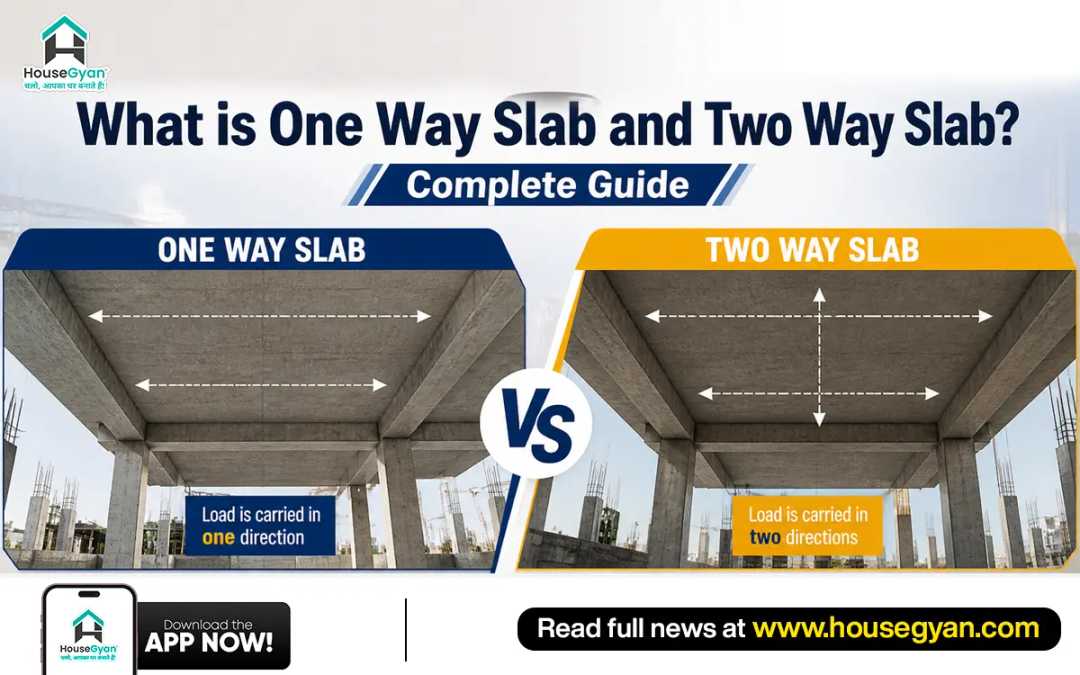
What is one way slab? It is a slab, which predominantly bends and supports weight in a single direction. Simply put, the one way slab meaning is that the load is shifted to a large extent on two sides which supports the load. The primary reinforcement is installed in the shorter direction of the span, and distribution steel in the longer direction. As per the one way slab span ratio formula, when the longer span is more than the short one, the slab is typically a one way slab.
Applications of one way slab:
-
narrow rooms
-
verandas
-
corridors
-
small residential spaces
-
longer length rectangular rooms.
Pros:
-
simpler design
-
easier shuttering and reinforcing.
-
suitable in narrow spans.
-
can be cost effective in small areas.
Cons:
-
not suited to square rooms
-
load transfer is not so balanced.
-
may require heavier beams in certain instances.
Read More:How to Plan House Construction in India: Step-by-Step Guide for First-Time Builders.
What Is a Two Way Slab? Uses, Pros, and Cons
What is two way slab? It is a slab, which is able to bend and load in both ways. Simply put, two way slab meaning is that the load is distributed to all four supporting sides hence reinforcement is required on both sides. It is the reason why two way slab reinforcement types details are not similar to one way slabs. Square or almost square rooms, which require a balanced distribution of loads, are usually provided with two way slabs.
Applications of two way slab:
-
square rooms
-
larger halls
-
living rooms
-
office floors
-
supported on four sides of a room.
Pros:
-
load is more evenly spread.
-
more suitable to bigger room panels.
-
are capable of decreasing the bending stress in a single direction.
-
appropriate to square or almost square designs.
Cons:
-
more complex design
-
reinforcement detailing is more entailed.
-
Shuttering and steel setting can be more expensive.
-
needs to be well engineered.
Read More:Best House Plan Designs for Indian Homes with Layout Ideas.
One Way Slab vs Two Way Slab: Key Differences
-
The primary difference between one way slab and two way slab lies in the transfer of loads.
-
The load flows in a single direction in a one way slab.
-
The load is distributed in both directions in a two way slab.
-
There is also a difference in reinforcement in one way slab vs two way slab.
-
One way slabs require primary steel in a single direction.
-
Two way slabs require steel on both sides.
-
One way slabs can be used in small rectangular areas.
-
Square or balanced room layouts are better suited to two way slabs.
Reinforcement Details in One Way and Two Way Slab
-
In one way slab and two way slab, reinforcement is based on the load carrying capacity of the slab.
-
In a one way slab, a main steel runs in one direction, normally the shorter direction.
-
Two way slab reinforcement details require steel on either side to provide balanced support.
Load Distribution in One Way and Two Way Slab
-
The main difference between one way slab and two way slab is load distribution.
-
The load moves primarily in a single direction, in one way slab meaning.
-
Two way slab meaning, the load is distributed both ways.
How to Identify One Way and Two Way Slab
Many house owners question how to identify one way slab and two way slab. The easiest technique is to verify the support system and ratio to span. When the type of slab reinforcement is supported on two opposite faces, then it tends to be a one way slab. Provided it is supported at four sides and the longer distance exceeds twice the shorter distance, it will also serve as a one way slab. A two way slab is a slab that is supported on four sides and has a ratio of the span that is less than 2 to 1.
Which Slab is Better for House Construction?
No one can say which slab is better for house construction as it will depend on the size of a room, the span, the layout, and the structural requirements. One way slab is normally suitable to narrow rectangular rooms and two way slab is suitable to square or matched rooms. In one way slab versus two way slab with example, an example of a corridor could be on a one way slab and Vs a square living room could be on a two way slab.
Cost Difference Between One Way and Two Way Slab
-
In one way slab vs two way slabs tend to be most cost effective.
-
The one way slab can be very economical as it is easier to reinforce and shutter.
-
Two way slabs tend to be more expensive due to requiring more intricate reinforcement and formwork.
Common Mistakes to Avoid
-
The most frequent error is believing that both types of slabs are applicable everywhere.
-
Lack of consideration of the span ratio when determining the type of slab may result in inappropriate design.
-
Reinforcement detailing is not a good thing to ignore, particularly in two way slabs.
-
Slab type is not the only factor, which should be considered by homeowners.
-
In the RCC slab design basics, short-term economy is less important than safety and structural stability.
Conclusion
Learning the one way slab and two way slab building is also essential in building safe houses. The primary difference lies in the way the slab supports load, and reinforcement is positioned. what is one way slab, what is two way slab, and all the fundamentals of a one way slab vs two way slab, then it becomes easier to settle on the right slab. The most good one varies according to the shape of the room, its span ratio, and the structure.
Why HouseGyan?
HouseGyan breaks down construction issues in easy terms to those constructing homes. We can make you a smarter home decision maker whether you want to learn the slab types in construction, the difference between designs, or more importantly, building basics.
FAQs
1. What is the difference between one way slab and two way slab?
Load transfer is one of the difference between one way slab and two way slab. One way slab will have its load in one direction only, whereas two way slab will have its load in both directions.
2. How do you identify a one way slab and two way slab?
To identify one way slab and two way slab, examine sides of support and span ratio. When the longer span exceeds the shorter span more than twice, then it generally is a one way slab.
3. Which slab is stronger: one way slab or two way slab?
There is the two way slab which has the ability to redistribute more evenly but requires that the strength is based on effective design, span and reinforcement.
4. Where is a one way slab commonly used in construction?
It is popularly applied in small rooms, hallways, loggias, and oblong areas.
5. Where is a two way slab commonly used in buildings?
It is usually applied in square rooms, halls, living rooms and spaces which are mounted on the four sides.
6. Which slab is better for house construction?
Slab type ought to be compatible with the shape and construction of the room. They can be both appropriate based on layout.