
Table Of Content ☰
- 1. Overview of Khasra and Khatauni Records
- 2. What is a Khasra Number?
- 3. Relationship Between Shajra (Village Map) and Khasra Number
- 4. Why is Khasra Number Important?
- 5. What Details Can Be Found Using a Khasra Number?
- 6. What is Khatauni?
- 7. The Process of Mutation (Dakhil-Kharij)
- 8. Roles of Revenue Officials
- 9. Legal Validity of Online Land Records
- 10. Regional Nomenclature Across India
- 11. Khasra vs Khatauni vs Khewat
- 12. How to Find Khasra Number in India (Step-by-Step)
- 13. How to Find Khatauni Details
- 14. State-Wise Land Record Portals
- 15. Common Issues in Khasra and Khatauni Records
- 16. Benefits of Understanding These Records
- 17. Conclusion
Land ownership in India depends heavily on revenue records. Whether you plan to buy land, sell property, apply for a bank loan, or verify ownership, you must understand these records clearly. One of the most important terms used in Indian land records is the Khasra Number.
Many people hear this term during land deals but remain confused about its meaning, legal value, and usage. This guide explains what a Khasra Number is, how it connects with Khatauni, and how you can find these details safely and correctly in India.
This article is written as a professional yet simple guide, suitable for first-time land buyers, property owners, and anyone dealing with land matters in 2026 and beyond.
Overview of Khasra and Khatauni Records
In India, land records are maintained by State Revenue Departments. These records help track:
Ownership of land
Exact land location
Area and boundaries
Land use and crop details
Among many records, two are most commonly used at the village level:
Khasra Number
Khatauni
They work together. One identifies the land, and the other identifies the owner. Understanding both is necessary for legal clarity.
Once you verify your land details using the Khasra number, the next step is planning your house budget. Use HouseGyan’s Home Construction Cost Calculator to get an accurate estimate.
What is a Khasra Number?
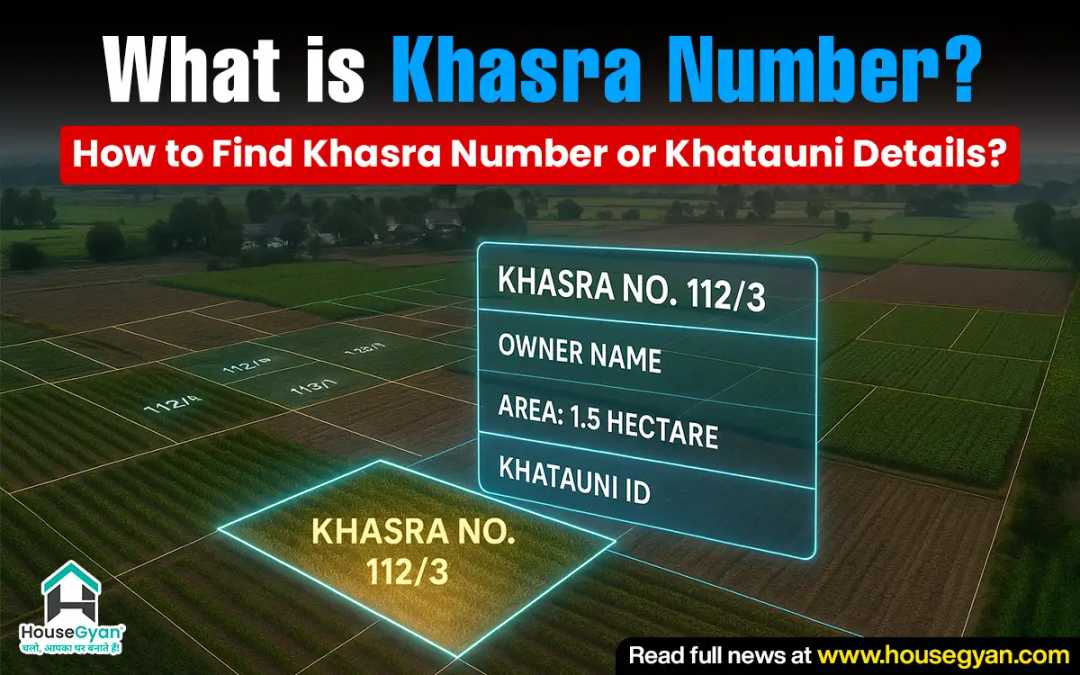
A Khasra Number is a unique identification number given to a specific piece of land in a village. It is mainly used for agricultural and rural land, though in some states it also applies to residential plots.
Each village is mapped and divided into parcels. Every parcel gets a khasra number.
Key Features of a Khasra Number
Identifies the exact land parcel
Is village-specific
Is linked to official land maps
Is maintained by the revenue department
Remains constant unless land is subdivided or merged
In simple terms, a khasra number works like a land plot ID.
Relationship Between Shajra (Village Map) and Khasra Number
A Shajra is the official village land map. It shows the physical layout of all land parcels in a village.
The Shajra shows the land visually
The Khasra is the written record of that map
Each numbered plot on the Shajra map corresponds to a khasra number in the written register. This means:
Shajra = Map
Khasra = Written details of the same map
Together, they help identify land boundaries and location accurately.
Why is Khasra Number Important?
The khasra number is required for almost all land-related work.
Main Uses
Proof of land identity
Property registration
Sale and purchase verification
Bank loan approval
Crop and agricultural records
Government surveys and compensation
Without a valid khasra number, land transactions become risky and legally weak.
What Details Can Be Found Using a Khasra Number?
A khasra number connects to several land details, such as:
Land area
Type of land (agricultural, residential, barren)
Crop details in farming land
Village, tehsil, and district
Linked ownership records
These details help buyers and owners understand the land before making decisions.
Land area in khasra records is written in different units. To understand the actual land size, you can use a land area calculator for unit conversion in India.
What is Khatauni?
Khatauni is a record of land ownership. It shows who owns the land and in what share.
One khatauni can include multiple khasra numbers if the same owner holds more than one land parcel.
Key Points About Khatauni
Maintained by the revenue department
Updated after ownership changes
Used as ownership proof in many cases
Linked directly to khasra numbers
The Process of Mutation (Dakhil-Kharij)
Many people think that once land is purchased, ownership updates automatically. This is not true.
Mutation, also called Dakhil-Kharij, is the process of updating ownership in revenue records.
Important Clarification
Khasra number identifies the land
Khatauni updates only after mutation
Until mutation is completed:
The old owner’s name may still appear
New ownership is not fully recorded in revenue records
Mutation is done after:
Sale
Inheritance
Gift deed
Court order
Roles of Revenue Officials
Patwari / Lekhpal
Maintains village land records
Updates khasra and khatauni entries
Conducts field verification
Tehsildar
Supervises revenue records
Certifies mutation orders
Issues certified copies
Both roles are essential for correct land records.
Legal Validity of Online Land Records
Online portals provide informational copies only.
For legal and bank purposes, you need a Certified Copy (Sarkari Nakal).
Important Note
Online printouts are not legally binding
Banks, courts, and registrars require certified copies
Certified copies are issued by the tehsil office
Regional Nomenclature Across India
Land record terms differ by region.
North and Central India
Khasra
Khatauni
Khewat (Khata)
Used in UP, MP, Haryana, Punjab, Bihar, Rajasthan
South India
Survey Number
Pahani / Adangal
Used in Karnataka, Andhra Pradesh, Telangana, Tamil Nadu
The purpose remains the same, but names and formats differ.
Khasra vs Khatauni vs Khewat
Record Type | Purpose | What It Shows |
Khasra Number | Land identification | Plot details, area, land type |
Khatauni | Ownership record | Owner name, land share |
Khewat (Khata) | Ownership account | List of owners and total holdings |
How to Find Khasra Number in India (Step-by-Step)
Before starting, keep these details ready:
Village name
Tehsil
District
Land record year
Method 1: Online State Land Record Portal
Visit the official state land records website
Select district, tehsil, village
Choose year
Search by owner name or khata number
View khasra details
Method 2: Through Khatauni
Enter khatauni number
View linked khasra numbers
Method 3: Offline Visit
Visit patwari or tehsil office
Carry old documents
Request record search
Many agricultural land records show area in hectares. Before buying land, it is useful to convert hectares to acres for clear comparison.
How to Find Khatauni Details
Online
Use state land portal
Search by name or khasra number
Download informational copy
Offline
Apply at tehsil office
Request certified copy
Pay prescribed fee
After confirming the plot size through Khasra records, planning the right house layout becomes easier. Explore house drawings and floor plans designed as per your plot dimensions.
State-Wise Land Record Portals
State | Portal Name |
Uttar Pradesh | Bhulekh UP |
Madhya Pradesh | MP Bhulekh |
Rajasthan | Apna Khata |
Bihar | Bhulekh Bihar |
Maharashtra | Mahabhulekh |
Karnataka | Bhoomi |
Punjab | Jamabandi |
Haryana | Jamabandi Haryana |
Common Issues in Khasra and Khatauni Records
Name mismatch
Old ownership entries
Wrong land area
Missing mutation
These must be corrected before registration or loan approval.
Benefits of Understanding These Records
Clear ownership proof
Safer land transactions
Easier loan processing
Reduced legal disputes
Better planning for construction
HouseGyan Offering | ||
Conclusion
The Khasra Number is the foundation of land identification in India, while Khatauni confirms ownership. Along with the Shajra map, mutation process, and certified records, these documents form the backbone of the Indian land revenue system.
Whether you are a landowner, buyer, or investor, understanding these records helps you avoid mistakes and legal risks. With growing digitization by 2026, access is easier, but legal awareness remains essential.
Accurate knowledge is the key to safe and secure land ownership in India.
FAQs
1. Is khasra number proof of ownership?
Ans. No. It identifies land. Ownership is confirmed through khatauni.
2. Can khasra number change?
Ans. Only if land is divided or merged.
3. Is mutation mandatory?
Ans. Yes. Without mutation, ownership is incomplete in records.
4. Are online land records valid in court?
Ans. No. Certified copies are required.
5. Who updates khasra and khatauni?
Ans. Patwari or Lekhpal, under Tehsildar supervision.