
The quality of drinking water depends on the source, leading to increasing concerns in Indian households. Many people are now comparing the difference between RO UV and UF purifiers, and various types of water purifiers before buying them. When looking for water purifier types explained, it is important to know RO vs UV vs UF and the RO UV UF difference.
What Are the Different Types of Water Purifiers?
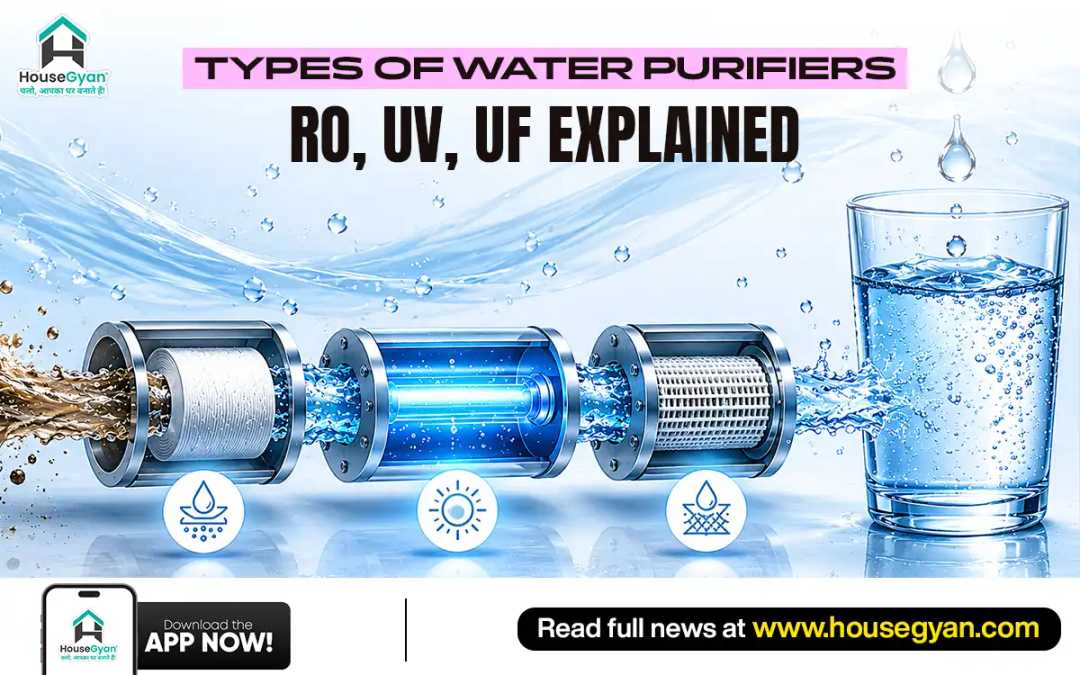
The main types of water purifiers RO UV UF explained depend on how each system cleans water.
RO water purifier eliminates dissolved salts, heavy metals, and most of the small impurities.
A UV water purifier uses ultraviolet light to kill bacteria and viruses.
A UF water purifier is a membrane filter that will remove suspended particles and some microbes, typically without electricity.
These are the most common systems used in home water filtration and drinking water purifier setups in India.
Why Water Purifiers Are Important for Indian Homes in 2026
Water problems such as fluctuating TDS, dissolved salts, pipeline contamination and dependence on borewell or tanker water are common in Indian homes. Therefore, which water purifier is best for Indian homes ? The best water purifier for home in India is dependent on the source of water and type of contamination. Water purifiers can aid with high TDS, bacteria, viruses, and overall drinking water quality.
Also Read: Top 10 Water Purifier Brands in India
What is an RO Water Purifier?
An RO water purifier will be used in order to remove dissolved salts, hardness, heavy metals and many fine impurities from the water. Generally preferred for high TDS borewell, tanker and mixed source water. If the dissolved contaminants are the primary concern, RO is the primary option in most RO vs UV vs UF water purifier comparison. In India, the popular brands with RO are KENT Grand Plus and Livpure or Aquaguard.
What is a UV Water Purifier?
UV water purifier is a technology that utilizes ultraviolet light to inactivate bacteria and viruses. Does not reduce TDS or remove dissolved salts - it is appropriate for low TDS water where microbial contamination is more important. UV purification is sometimes used on treated city water.
What is a UF Water Purifier?
A UF water purifier is a kind of filter that is made up of a membrane, where the membrane is used to eliminate the suspended particles and eliminate some microorganisms. Its biggest advantage is that it can work without electricity. But it cannot remove dissolved salts such as RO and it is better suited for low TDS water or basic home water filtration application.
RO vs UV vs UF Water Purifier: Key Differences
RO
Destroy dissolved salts, hardness and many micro-impurities
Ideal for high TDS borewell, tanker and mixed-source water
Needs electricity and usually has higher maintenance cost
May cause some water wastage during purification
UV
Kills bacteria and viruses with ultraviolet light.
Good for low TDS water conditions where microbiological contamination.
Needs electricity to work.
Does not remove dissolved salts or heavy metals.
UF
Filters out suspended particles and some microbes using a membrane
Ideal for simple filtration in low TDS water
Usually works without electricity.
Does not remove dissolved salts like RO.
Which Water Purifier is Best for Indian Homes?
The home water purifier depends on the actual water source. If the borewell or tanker water is high TDS, then generally, Ro or Ro+Uv+Uf Type systems are preferred. UV or UV+UF may be sufficient for municipal water with low TDS that may contain microbial contaminants. This is why which water purifier is best for Indian homes. The best water purifier for Indian homes isn't just a matter of brand, but also of water quality.
How to Choose the Right Water Purifier for Your Home
Always measure the TDS level of the water first.
if it comes from borewell, tanker or municipal.
Think about family size and how much storage space is needed daily.
Consider the maintenance budget and filter replacement costs.
Best Water Purifier Technology for Borewell and Municipal Water
In the case of borewell water, RO is typically the better option due to its increased TDS, hardness, and dissolved impurities. If the TDS level is already low and the primary concern is the microbial contamination, then the UV or UF can be considered in the case of municipal water. That's why RO is regarded as the best purifier for borewell water in India.
Latest Water Purifier Trends in India 2026
More and more, multi-stage purification and water-saving RO systems are used.
Mineral retention and smart features are also desired by buyers.
Water Purifier Price in India 2026 Explained
Actual pricing depends on the technology, size and options.
Basic UF and gravity purifiers cost less, while RO+UV+UF models are priced higher
Prices for Livpure Liv-Pep-Pro-Plus are ₹6,999, Livpure Pep Pro at ₹9,499, V-Guard Rejive RO at ₹11,499, and KENT Grand Plus at ₹16,990.
Common Mistakes to Avoid While Buying a Water Purifier
Never purchase without knowing TDS.
Avoid using UV & UF for high-TDS water.
Don't forget maintenance and filter expenses.
Look for the source of the water, don't just consider the brand.
Conclusion
Indian homes face different water issues, so many buyers compare the types of water purifiers before buying. Understanding RO vs UV vs UF and the RO UV UF difference clarifies your choice of the best water purifier for home. In India, popular models are Livpure Liv-Pep-Pro-Plus priced at about ₹6,999 and KENT Grand Plus priced at about ₹16,990.
FAQs
1. Which water purifier is best: RO, UV, or UF?
This varies with the water source and TDS. Typically, RO is best for high TDS water and UV or UF is good for low TDS supply.
2. Is RO purifier necessary for municipal water supply?
Not always. Depending upon contamination risk, if the TDS concentration is low, UV or UF can be sufficient.
3. What is the ideal TDS level for drinking water?
TDS impacts flavor and water quality and the proper purifier ought to match the real TDS of the source water you utilize.
4. Which water purifier works without electricity?
Generally a UF water purifier can operate without power.
5. Can UV purifiers remove dissolved salts and heavy metals?
No. UV does not do as good a job removing dissolved salts or heavy metals as RO does.
6. Which water purifier is best for borewell water in India?
RO or RO+ UV+UF is the best purifier for borewell water in India.