
Table Of Content ☰
Building a house starts much before the first brick is placed. One of the most important steps is understanding the soil on which the house will stand. In India, soil type changes from place to place. This directly affects how strong and safe a house foundation will be.
Many people focus on design, materials, and budget, but ignore soil testing. This can lead to cracks, uneven floors, and high repair costs later. Learning about the types of soil for building house foundations helps homeowners make better decisions and avoid future problems.
Before planning the foundation, it is also useful to estimate the overall construction budget. Tools like the house construction cost calculator help homeowners understand expected costs early and plan foundation work accordingly.
This guide explains different types of soil for building house foundations in India, their properties, and how each soil affects foundation design. The goal is to help you build a safe and long lasting home in 2026 and beyond.
Why Soil Type Matters for House Foundations
Soil acts as the base that carries the full weight of a house. If the soil is weak or unstable, the foundation may sink or crack over time. This can damage walls, floors, and even plumbing.
Understanding soil for building house foundations helps in:
-
Choosing the right foundation type
-
Preventing uneven settlement
-
Improving building safety
-
Reducing repair and maintenance costs
Different soils behave differently when exposed to water, load, and seasonal changes. This is why soil testing is a key step before construction begins.
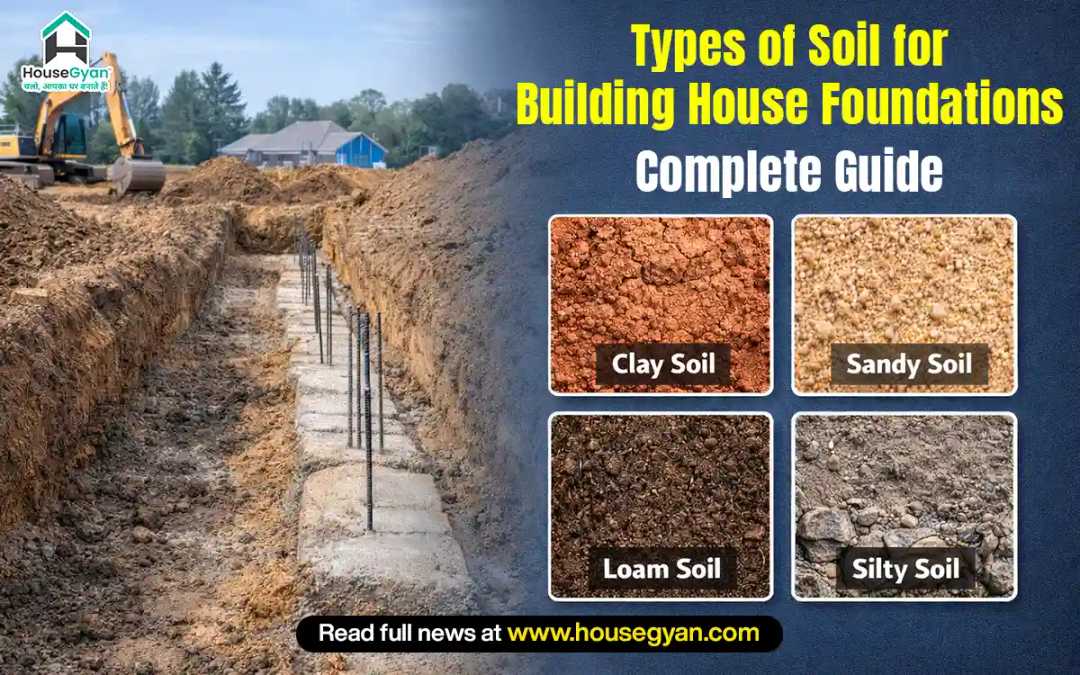
8 Common Types of Soil for Building House Foundations in India 2026
India has a wide variety of soil types due to its diverse climate and geography. Below are the main types of soil for building house foundations found across the country.
Clay Soil
Characteristics of Clay Soil
Clay soil has very fine particles. It can hold water for a long time and becomes sticky when wet.
Key features:
-
High water retention
-
Expands when wet and shrinks when dry
-
Very dense structure
Suitability for Foundations
Clay soil can support heavy loads, but it creates problems due to expansion and shrinkage. This movement can cause cracks in foundations and walls.
Foundation Tips for Clay Soil
-
Deep foundations are preferred
-
Proper drainage is very important
-
Soil stabilization methods may be required
Clay soil is common in parts of central and southern India.
Sandy Soil
Characteristics of Sandy Soil
Sandy soil has large particles and feels gritty. Water drains quickly through it.
Key features:
-
Good drainage
-
Low water retention
-
Loose structure
Suitability for Foundations
Sandy soil is generally good for foundations if compacted properly. It does not expand or shrink much.
Foundation Tips for Sandy Soil
-
Proper compaction is required
-
Shallow foundations can work
-
Extra care needed near coastal areas
Sandy soil is found in desert regions and coastal belts of India.
Silt Soil
Characteristics of Silt Soil
Silt soil has medium sized particles, smaller than sand but larger than clay.
Key features:
-
Smooth texture
-
Moderate water retention
-
Easily eroded by water
Suitability for Foundations
Silt soil has lower strength compared to sand and clay. It can become unstable when wet.
Foundation Tips for Silt Soil
-
Avoid construction on loose silt
-
Soil strengthening may be required
-
Good drainage systems are important
Silt soil is common near riverbanks and flood plains.
Loamy Soil
Characteristics of Loamy Soil
Loamy soil is a mix of sand, silt, and clay. It is considered one of the best soil types.
Key features:
-
Balanced water retention
-
Good strength
-
Stable structure
Suitability for Foundations
Loamy soil is ideal for building house foundations. It offers good load bearing capacity and minimal movement.
Foundation Tips for Loamy Soil
-
Standard foundations usually work well
-
Basic soil testing is still recommended
Loamy soil is found in many agricultural regions of India.
|
HouseGyan Offering | ||
Black Cotton Soil
Characteristics of Black Cotton Soil This soil is rich in clay and is also called expansive soil. Key features: High swelling and shrinkage Retains water for long periods Weak during rainy seasons Suitability for Foundations Black cotton soil is challenging for house foundations. It can cause severe structural damage if not treated properly. Foundation Tips for Black Cotton Soil Deep pile foundations are recommended Soil replacement or stabilization may be needed Strong drainage is essential This soil is common in Maharashtra, Madhya Pradesh, and parts of Gujarat. Characteristics of Laterite Soil Laterite soil is rich in iron and aluminum. It is usually red in color. Key features: Hard when dry Poor water retention Moderate strength Suitability for Foundations Laterite soil can support construction if it is well compacted. Foundation Tips for Laterite Soil Shallow foundations can be used Surface leveling is important Laterite soil is found in coastal Karnataka, Kerala, and eastern India. Characteristics of Alluvial Soil Alluvial soil is formed by river deposits and is very fertile. Key features: Fine to coarse particles Good moisture holding capacity Varies in strength Suitability for Foundations Alluvial soil can be good or weak depending on depth and moisture content. Foundation Tips for Alluvial Soil Soil testing is very important Foundation depth depends on soil layers This soil is common in the Indo Gangetic plains. Characteristics of Rocky Soil Rocky soil consists of solid rock or large stones. Key features: Very high strength Low water absorption Hard to excavate Suitability for Foundations Rocky soil is excellent for foundations due to its strength. Foundation Tips for Rocky Soil Shallow foundations are usually enough Blasting or heavy equipment may be required Rocky soil is found in hilly and plateau regions. Soil testing checks soil strength, moisture content, and bearing capacity. It helps engineers decide: Foundation depth Foundation type Safety measures For Indian homes, soil testing is a small cost compared to the long term benefits it provides. Know More: How Soil Testing Impacts Your Homes Design and Foundation Different soils require different foundation solutions. Some common foundation types include: Isolated footing Raft foundation Pile foundation Strip foundation Matching soil for building house foundations with the right foundation type improves safety and durability. Understanding the types of soil for building house foundations is a key step in safe home construction. Each soil type behaves differently and affects foundation design, cost, and durability. By identifying the right soil for building house foundations and choosing suitable foundation methods, homeowners can avoid future structural problems. Soil testing, proper planning, and expert guidance help create strong and long lasting homes. In 2026, informed construction decisions are more important than ever. Knowing your soil is the first step toward building a secure and reliable house. HouseGyan helps homeowners understand complex construction topics in a simple way. Soil type and foundation planning can be confusing, especially for first time home builders. Clear guidance helps avoid costly mistakes. HouseGyan also provides easy tools and expert based information to support better planning decisions. This helps homeowners feel confident before starting construction. Easy to understand construction guides Cost planning tools for early budgeting Practical tips based on Indian conditions Start your home planning with the right knowledge and make informed decisions from day one. Ans. Soil testing helps identify soil strength and behavior. It prevents foundation failure and structural damage. Ans. Loamy and rocky soils are considered best due to good strength and stability. Ans. Clay soil is not bad, but it needs special foundation design due to expansion and shrinkage. Ans. Yes, but it requires deep or pile foundations and proper soil treatment. Ans. Foundation depth depends on soil type, load, and local conditions. Soil testing gives accurate guidance.
Laterite Soil
Alluvial Soil
Rocky Soil
How Soil Testing Helps in Foundation Planning
Choosing the Right Foundation Based on Soil Type
Conclusion
Why HouseGyan?
How HouseGyan Supports Home Builders
FAQs
1. Why is soil testing important before building a house?
2. Which soil is best for building house foundations?
3. Is clay soil bad for house construction?
4. Can a house be built on black cotton soil?
5. How deep should a foundation be in India?