
Table Of Content ☰
What Is Construction Glass?
Construction glass refers to glass products used in residential and commercial constructions. Heat processing, laminating, tinting, coatings, and patterns are the manufacturing treatments used to enhance strength, safety, insulation, light control, and appearance.
Why Is Glass Used in Construction?
Glass supports modern architectural designs and allows natural light to the exterior of the structure. It may also enhance safety, thermal performance, solar control, and privacy, as well as acoustic comfort, depending on the nature.
12 Types of Glass Used in Construction
1. Float Glass
Float glass is a simple flat glass of glass that is formed by floating molten glass on molten tin. It is a clear and smooth surface, and it is the foundation of lots of other glass products.
2. Toughened Glass
Glass that has undergone hardening or complete tempering is subjected to slow and fast cooling. It is far stronger than normal annealed glass and fractures into smaller parts when it malfunctions.
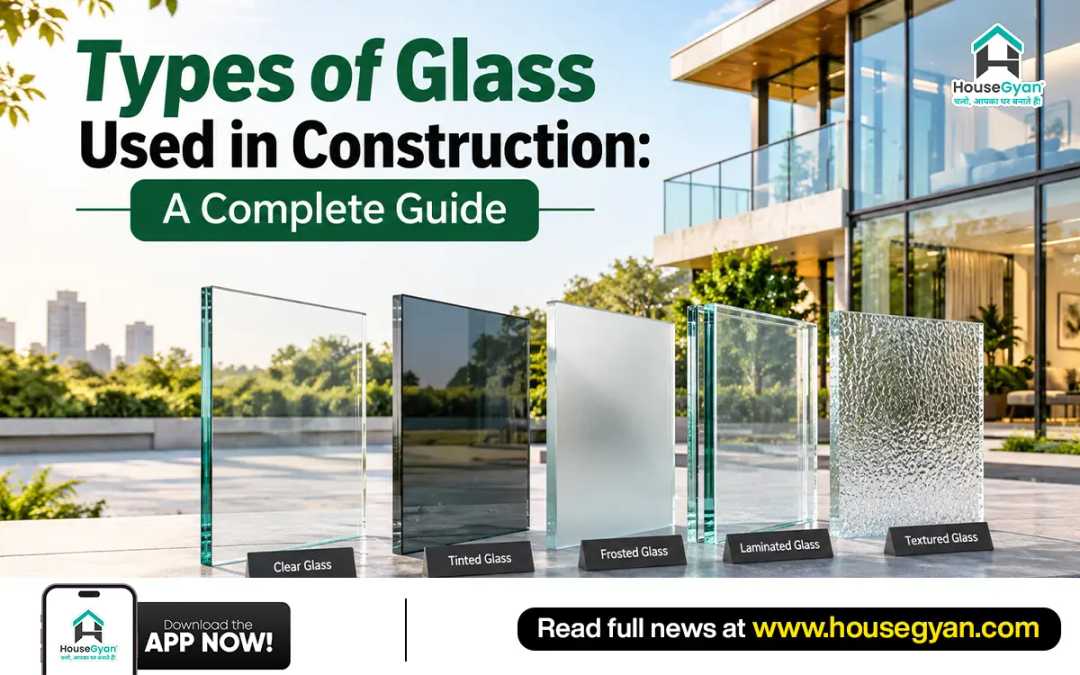
3. Laminated Glass
Laminated glass is made by using two or more layers of glass and an interlayer. The interlayer keeps the fragments together when damaged, and it is applicable in places where security and safety count.
4. Double-Glazed Glass
Two panes of glass are separated by a cavity that is not broken in double glazing; the cavity may hold air or some form of other gas and offers better thermal insulation than single glazing.
5. Low-E Glass
Low-E glass has a low-emissivity coating that restrains the transfer of heat but allows beneficial daylight to pass; it will be able to minimize heating or cooling loads depending on the one chosen.
6. Tinted Glass
Colored glass is made with color in the glass, inhibiting light transmission, and useful in the control of solar heat and glare. The most frequent ones are grey, bronze, green, and blue.
7. Reflective Glass
Reflective glass is reflective due to a coating that partly reflects sunlight and minimizes glare and solar heat gain; it is commonly applied to business buildings and structures.
8. Frosted Glass
Frosted glass contains a transparent layer that makes it less visible but transparent to light. It is suitable in bathrooms, office partitions, doors, and privacy areas.
9. Wired Glass
Wired glass involves a mesh of wire built into the glass. It has traditionally been used in fire-rated windows and doors, but its use must follow applicable safety and building requirements.
10. Patterned Glass
Patterned glass has a textured design on one or both surfaces; it can provide privacy while allowing light through and is often used for decorative windows, doors, and partitions.
11. Heat-Strengthened Glass
Controlled heating and cooling of heat-strengthened glass is done to enhance strength and thermal stress resistance. It is mostly stronger than annealed glass; however, it is not necessarily considered safety glass.
12. Insulated Glass Unit (IGU)
An Insulated Glass Unit (IGU) is a combination of two or more glass panes but with sealed cavities in-between; the design can include air or gas fills and low-E coatings to improve thermal performance.
Read More: Top 10 Glass Manufacturing Companies in India 2026.
Types of Glass Based on Construction Application
Read More: 13 Popular Types of Window Glasses for Your Home.
How to Choose the Right Glass for Construction?
-
Determine the place of location and the use of the building and the glass.
-
Durability through checks, security, thermal efficiency, and sun protection.
-
Consider lighting and privacy needs.
-
Choose low-e/insulated glass to improve energy performance.
-
Doors and railings have appropriate safety glazing.
-
Frame compatibility and the check glass thickness.
-
Consider the nature of its installation and upkeep.
Advantages of Using Glass in Construction
-
Brings natural daylight indoors.
-
Provides outdoor views.
-
Promotes contemporary architecture.
-
Can improve thermal performance.
-
has privacy and solar-control choices.
-
Provides different safety and strength levels.
-
Creates flexible aesthetic choices.
Conclusion
Glass construction comes in various forms, ranging between simple glazing and privacy to safety and energy efficiency. Float systems, toughened systems, laminated systems, low-E systems, double-glazed systems, and also IGU systems have their own advantages. Choose glass, depending on the use, building needs, climate, safety factors, and preferred performance.
Why HouseGyan?
HouseGyan is an easy and convenient source of information on home construction, interiors, materials, renovation, and maintenance. Our guides will make sense of the technical issues and make educated decisions about their homes.
FAQs
1. Which type of glass is commonly used in construction?
It is a common use of float glass as a simple flat glass and in the production of other glass products.
2. What is the difference between toughened and laminated glass?
Heat-treated glass is hardened to be strong, and laminated glass contains a layer between that holds the fragments together.
3. Which glass is best for building windows?
Low-E or GU glass and double glazes can provide better insulation and energy performance.
4. Is laminated glass safer than ordinary glass?
Yes. Its interlayer is designed to hold broken glass together, which enhances safety.
5. What is Low-E glass used for?
Low-E glass misses the transfer of heat and enhances thermal performance.
6. Which glass is suitable for glass facades?
Facades may be covered with low-E, insulated, laminated, and tinted glass depending on the design, climatic conditions, and the requirements of safety.