
Table Of Content ☰
- Introduction to Open Kitchen Designs in India
- Understanding Why Open Kitchens Are Failing Indian Homes?
- Impact of Open Kitchens on Daily Lifestyle
- Small carpet areas in urban apartments
- Open Kitchen vs Closed Kitchen in India
- How to Fix an Open Kitchen Without Major Renovation
- Future of Kitchen Design Trends in India
- FAQs About Why Open Kitchens Are Failing Indian Homes?
- Conclusion
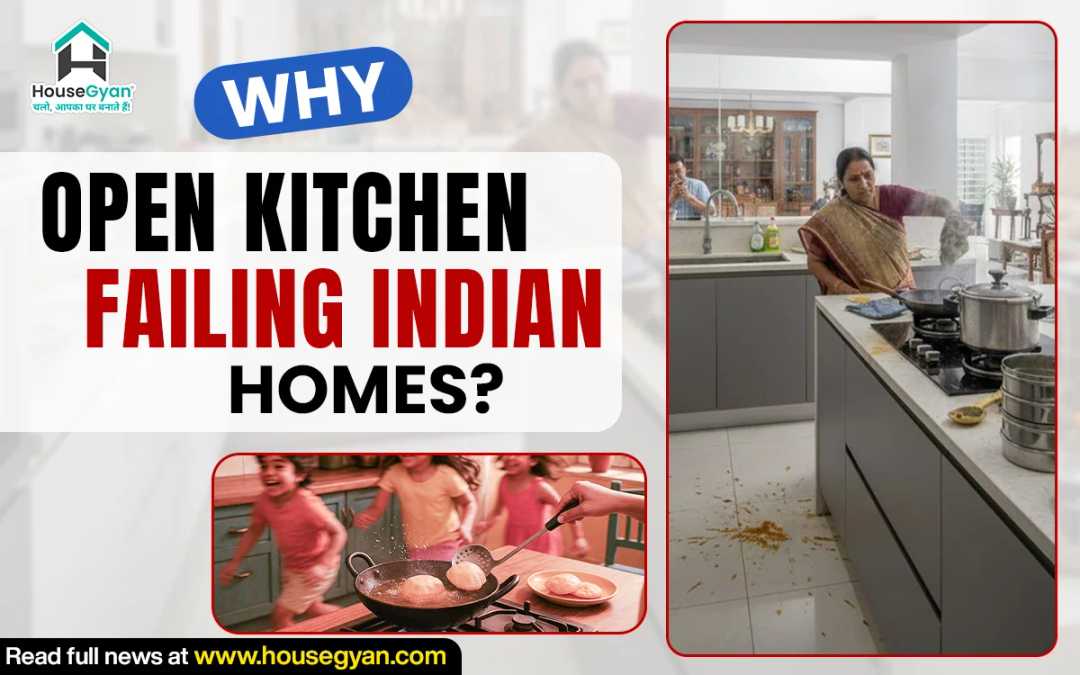
Why Open Kitchens Are Failing Indian Homes? This question is becoming more common as families realize their modern layouts may not suit traditional lifestyles. While open kitchens offer a sleek, spacious look, many Indian households are now finding them impractical for daily cooking, hosting, and maintenance. This article explores the cultural, design, and lifestyle reasons behind this growing dissatisfaction and why homeowners are shifting toward semi-open or fully closed designs.
Introduction to Open Kitchen Designs in India
Modern evolution of Indian home layouts
Open kitchens entered the Indian real estate market as part of a modern, Western-inspired design trend. They promised a sense of openness, better light flow, and integrated living spaces. As urban apartments began shrinking, open kitchens seemed like the perfect solution to make homes appear larger.
Increasing popularity of Western-style open concepts
Indian builders marketed open kitchens as “luxury features,” appealing to younger buyers fascinated by global design. But soon enough, homeowners noticed the cracks beneath the surface—practical problems that affected everyday life.
Understanding Why Open Kitchens Are Failing Indian Homes?
Cultural mismatch with traditional cooking habits
Indian cooking isn’t mild, minimal, or odor-free. It’s flavorful, intense, and vibrant.
High-heat tadka, deep-frying, and aromatic spices
Tadka splatters, masala roasting, and frying puris or pakoras produce strong aromas and oil particles. In an open kitchen, these smells travel freely to the living room, sofa fabrics, dining space, curtains, and even bedrooms.
Daily meal-prep patterns unique to Indian households
Indian families often cook multiple times a day. That means repeated exposure to steam, smoke, and smells throughout the house—something open spaces struggle to contain.
Ventilation challenges in compact apartments
Inadequate chimney capacity for Indian cooking
Most standard chimneys are built for mild cooking. Indian dishes require a high-suction chimney (at least 1200–1500 m³/hr). Many homes either don’t have one or have poorly installed units.
Odor circulation through the living area
Open kitchens don’t trap odors. As a result, even light cooking can permeate into the main seating area, making it unpleasant for guests and family members.
Noise and clutter visibility
Pressure cooker whistles and mixer-grinder noise
Indian appliances are loud—mixers, grinders, juicers, and pressure cookers all disrupt conversations and entertainment in open layouts.
Lack of visual separation for utensils and prep work
On busy weekdays, dishes pile up quickly. In open kitchens, clutter is always on display, adding social pressure to keep things spotless at all times.
Privacy concerns in multi-generational homes
In joint or semi-joint families, cooking is a private activity. Open kitchens remove that boundary, making members uncomfortable when guests or unexpected visitors arrive.
Know More: Kitchen Interior Design Ideas
Impact of Open Kitchens on Daily Lifestyle
Managing guests and maintaining social boundaries
In traditional Indian culture, guests are often served in the living room. Open kitchens make it hard to maintain a separation between hosting and household work.
Increased maintenance and cleaning frequency
Even small cooking sessions lead to grease and dust settling across the living area, doubling cleaning efforts.
Limitations for house-help-managed kitchens
Many Indian homes rely on house help. An open kitchen puts their daily work on display, leading to awkwardness for both parties.
Design & Architectural Issues in India
Small carpet areas in urban apartments
Most Indian apartments under 1,500 sq ft struggle to accommodate open kitchens without compromising space zoning.
Inadequate planning by builders and developers
Builders often copy Western layouts without adjusting for Indian cooking habits.
Poor zoning between cooking, dining, and living
With no boundaries, activities clash—cooking overlaps with eating, watching TV, studying, or entertaining guests.
Open Kitchen vs Closed Kitchen in India
Advantages & disadvantages table
Hybrid or semi-open kitchen alternatives
Many families now opt for sliding glass doors or half-wall designs to mix openness with practicality.
Read More: Open kitchens Vs Closed kitchen
How to Fix an Open Kitchen Without Major Renovation
Sliding glass partitions
They preserve the visual openness while blocking fumes and noise.
Using island counters as visual dividers
Islands act like functional boundaries between kitchen and living areas.
High-power chimneys and air purifiers
Upgrading to high-suction chimneys and adding air purifiers reduces odor spread dramatically. For reliable recommendations, explore platforms like HouseGyan for modern layout inspirations.
Future of Kitchen Design Trends in India
Shift toward flexible and convertible layouts
Homeowners prefer adaptable designs that switch between open and closed modes as needed.
Builder trends in new housing projects
Developers increasingly include semi-open kitchens in new apartments to balance aesthetics and functionality.
FAQs About Why Open Kitchens Are Failing Indian Homes?
1. Are open kitchens suitable for heavy Indian cooking?
Not usually. They struggle with heat, smoke, and odors produced by Indian cooking styles.
2. Can open kitchens be modified without reconstruction?
Yes—glass partitions, chimneys, and layout adjustments can help.
3. Do open kitchens increase home cleaning needs?
Absolutely. Oil and dust spread more widely, increasing upkeep.
4. Why do guests feel uncomfortable with open kitchens?
Because the cooking process is fully visible, including clutter or utensils.
5. Is a semi-open kitchen better for Indian homes?
Yes, it offers the openness of modern design with the practicality of closed kitchens.
6. Why Open Kitchens Are Failing Indian Homes?
Because they clash with Indian cooking habits, cultural expectations, noise levels, and lifestyle patterns, making them difficult to maintain on a daily basis.
Conclusion
Why Open Kitchens Are Failing Indian Homes? The answer lies in a mix of cultural, practical, and design challenges. While open kitchens look appealing in magazines and model homes, they don’t align well with the realities of Indian cooking and daily life. Fortunately, hybrid and semi-open designs now offer the perfect balance between style and functionality.