
Table Of Content ☰
- Understanding the Basics of Red Brick and Fly Ash Brick
- What Are Red Bricks?
- What Are Fly Ash Bricks?
- Difference Between Red Brick and Fly Ash Brick
- Compressive Strength and Durability
- Weight and Size Consistency
- Thermal and Sound Insulation Qualities
- Water Absorption and Efflorescence
- Environmental Impact and Sustainability
- Energy Consumption in Production
- Construction Efficiency and Workability
- Mortar Consumption and Finishing
- Cost Comparison – Red Brick vs Fly Ash Brick
- Aesthetic and Design Considerations
- Regional Suitability for Each Brick Type
- Expert Recommendations for Home Builders
- Frequently Asked Questions (FAQs)
- Conclusion – Choosing the Right Brick for Your Dream Home
Understanding the Basics of Red Brick and Fly Ash Brick
The choice between red brick and fly ash brick plays a crucial role in determining your home’s durability, cost, and sustainability. While red bricks have been used for centuries in traditional construction, fly ash bricks are modern, eco-friendly alternatives gaining popularity in urban projects.
Let’s understand the basics before diving into the comparison.
What Are Red Bricks?
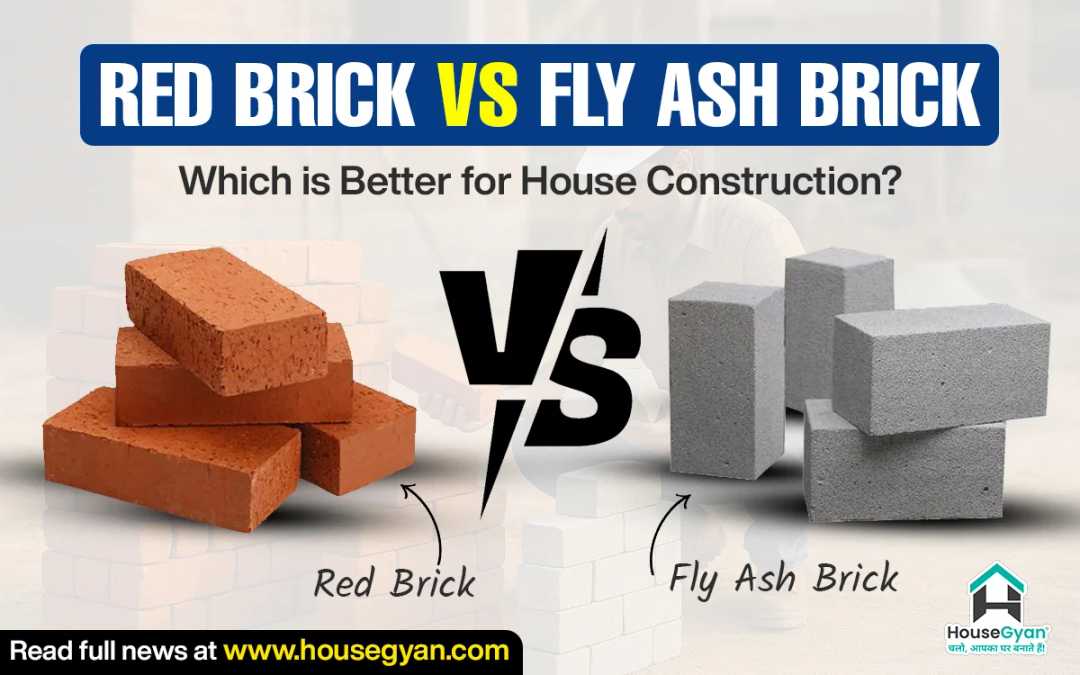
Red bricks are made from natural clay and baked in kilns at high temperatures (around 900–1100°C).
They’ve been a trusted material for centuries due to their strength, natural look, and local availability.
Key Characteristics:
Color: Reddish-brown due to iron oxide content.
Shape: Slightly irregular because of manual molding.
Manufacturing: Energy-intensive; requires large quantities of fertile topsoil.
Applications: Load-bearing walls, boundary walls, and general masonry.
What Are Fly Ash Bricks?
Fly ash bricks are made using fly ash, a byproduct from thermal power plants, combined with cement, sand, and gypsum. They are machine-pressed and cured under steam, not fired in kilns, making them more eco-friendly.
Key Characteristics:
Color: Light gray to bluish.
Shape: Uniform with sharp edges.
Manufacturing: Uses industrial waste, conserving soil and reducing pollution.
Applications: High-rise buildings, compound walls, and non-load-bearing structures.
Difference Between Red Brick and Fly Ash Brick
Compressive Strength and Durability
Fly ash bricks outperform red bricks in compressive strength, meaning they can bear higher loads without cracking.
Red bricks, however, offer proven long-term reliability for traditional homes but may weaken if poorly baked.
Verdict: Fly ash bricks win for high-rise or modern constructions needing uniform load distribution.
Want to calculate the cost use Brick Price Calculator
Weight and Size Consistency
Red bricks are manually molded, leading to inconsistent dimensions and alignment issues during masonry work. Fly ash bricks, being machine-pressed, offer consistent size, reducing mortar usage by 25–30%.
Verdict: Fly ash bricks ensure faster construction and better alignment.
Thermal and Sound Insulation Qualities
Red bricks provide better thermal insulation due to their porous structure, keeping interiors cooler in hot climates. Fly ash bricks, though denser, absorb more heat.
Verdict:
For hot regions – Red brick performs better.
For temperate or air-conditioned buildings – Fly ash bricks are suitable.
Water Absorption and Efflorescence
High water absorption in red bricks can lead to damp walls and white efflorescence stains. Fly ash bricks absorb less water and are more resistant to efflorescence due to their low lime content.
Verdict: Fly ash bricks offer better moisture resistance.
Environmental Impact and Sustainability
Fly ash bricks are champions of sustainable construction.
They recycle waste materials, prevent air pollution, and reduce dependency on fertile clay soil.
Energy Consumption in Production
Red Bricks: High energy, large carbon emissions, and deforestation from clay extraction.
Fly Ash Bricks: Low energy, no kiln firing, and upcycling of industrial waste.
Verdict: Fly ash bricks are significantly more eco-friendly.
Construction Efficiency and Workability
Red bricks are easier for masons used to traditional methods. However, fly ash bricks, being uniform in size, allow faster construction and less plastering work.
Mortar Consumption and Finishing
Fly ash bricks require less mortar due to their precise edges. Red bricks, on the other hand, need thicker plaster layers to achieve a smooth finish.
Verdict: Fly ash bricks save up to 10–15% in construction costs from reduced mortar and plaster.
Cost Comparison – Red Brick vs Fly Ash Brick
Verdict: Fly ash bricks are 15–20% more economical for large-scale construction.
Know More: AAC Blocks vs Clay Bricks
Aesthetic and Design Considerations
Red bricks naturally have warm, earthy tones that enhance architectural appeal — ideal for exposed brick finishes.
Fly ash bricks require plaster or paint for aesthetics but offer smooth surfaces for modern designs.
Verdict:
For rustic or traditional homes – Choose red brick.
For modern minimalistic buildings – Go with fly ash brick.
Regional Suitability for Each Brick Type
Expert Recommendations for Home Builders
Use fly ash bricks for urban homes, duplexes, or multi-story buildings.
Use red bricks for individual houses or rustic designs where natural aesthetics matter.
For hybrid projects, combine both — red brick for exterior look, fly ash for internal walls.
Frequently Asked Questions (FAQs)
1. Which brick is stronger — red or fly ash?
Fly ash bricks are stronger, with compressive strength up to 12 MPa compared to 7 MPa for red bricks.
2. Are fly ash bricks safe for residential buildings?
Yes, fly ash bricks are completely safe and non-toxic, as they are cured and not fired.
3. Which is better for hot climates?
Red bricks are more thermally efficient and ideal for hot regions.
4. Can red and fly ash bricks be used together?
Yes, many builders use red bricks for facades and fly ash bricks for internal walls.
5. Which brick has a longer lifespan?
Both can last over 100 years with proper maintenance, though fly ash bricks resist weathering better.
6. Which brick is more sustainable?
Fly ash bricks win hands down due to recycling of waste materials and reduced pollution.
Conclusion – Choosing the Right Brick for Your Dream Home
When comparing red brick vs fly ash brick, the right choice depends on your budget, design goals, and environmental priorities.
Choose red bricks if you value natural aesthetics and traditional strength.
Choose fly ash bricks for cost savings, precision, and sustainability.
In 2025, as eco-friendly construction gains prominence, fly ash bricks stand out as the smarter, greener, and more economical choice for modern homes.