
Table Of Content ☰
- 1. What is PCC in Construction?
- 2. What is RCC in Construction?
- 3. RCC vs PCC in Construction: Key Differences
- 4. Uses and Advantages of PCC in Construction
- 5. Uses and Advantages of RCC in Construction
- 6. Which is Better for House Construction?
- 7. RCC vs PCC Cost Comparison in India 2026
- 8. Common Mistakes to Avoid
- 9. Conclusion
- 10. Why HouseGyan?
- 11. FAQs
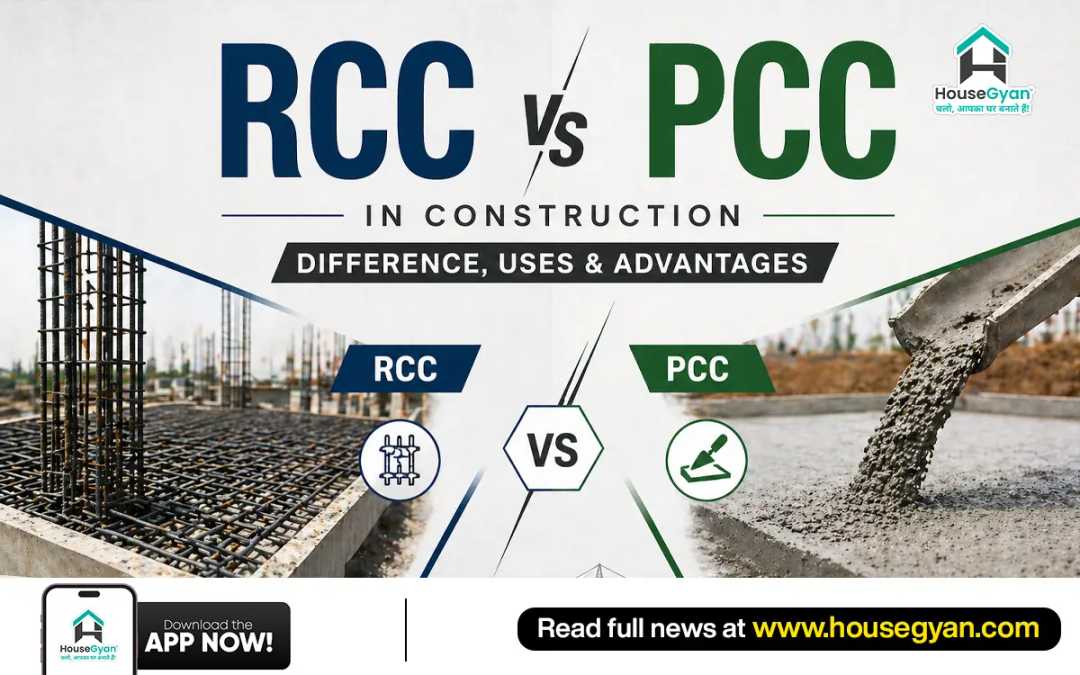
RCC vs PCC are often used in house construction, but what do they mean? The main difference between RCC and PCC is that while PCC is pure concrete, RCC is reinforced concrete with steel bars. This makes a difference in their strength, application and cost. Knowing what RCC and PCC allows homeowners to choose the right construction material.
What is PCC in Construction?
PCC meaning in construction stands for Plain Cement Concrete, which is a mix of cement, sand, coarse aggregate and water, but no steel bars. In RCC and PCC in construction, PCC used in house construction is primarily used for non-structural bases because it is good in compression but not in tension. House construction uses PCC as foundation base, floor base and base for RCC. If you are searching what is RCC and PCC, then PCC is the foundation concrete for the structure.
What is RCC in Construction?
RCC meaning in civil engineering stands for Reinforced Cement Concrete. It is a combination of concrete and steel bars or steel mesh, where concrete is used to bear the compression and steel is used to bear the tension and bending. This is why RCC and PCC in construction are different. RCC uses in building construction is used for slabs, beams, columns, footings and other structural elements. This is why, in the case of RCC slab vs PCC slab, the former is more feasible and practical.
Read More: Housegyan’s RCC Price Calculator.
RCC vs PCC in Construction: Key Differences
-
The difference between RCC and PCC is the reinforcement.
-
PCC does not include steel bars or mesh, but RCC does.
-
PCC concrete is used for foundation and simple structural works in RCC vs PCC concrete
-
Structural work is done with RCC which is stronger in compression, tension, bending and shear.
-
PCC is cheaper as it's easier to mix and lay down.
-
RCC is more expensive because it requires steel, shuttering, formwork and labour.
-
To explain simply, PCC is the base for the structure, and RCC is the structural frame.
-
This is the simplest way to learn the difference between RCC and PCC with examples.
Uses and Advantages of PCC in Construction
The primary uses of PCC in foundation work are to level the soil, provide a base for footings, prevent corrosion of the reinforcement by keeping it away from the soil and to provide a clean surface to work on. It is also used under flooring and pavements, and occasionally for some non-structural items such as roads or drains.
Advantages of PCC:
-
economical
-
easy to mix and place
-
provides a stable base
-
resists ground water
-
can be used before structural concrete
Uses and Advantages of RCC in Construction
RCC uses in building for slabs, beams, columns, lintels, foundations and frames. RCC is used wherever a structure needs to safely carry loads. It is vital for roof slabs and structural members in houses as these elements are subject to bending, tension and load transfer.
Advantages of RCC:
-
high structural strength
-
resistant to bending and tension
-
suitable for load-bearing members
-
long lasting if designed and cured correctly
-
suitable for construction of modern houses
Which is Better for House Construction?
If you are wondering RCC vs PCC which is better for house construction, the answer is: both are required, but for different applications. So, RCC vs PCC, RCC is better, but PCC is perfect in the foundation and levelling. Typically, a house begins with a base of PCC and then RCC is used to build the structure.
Read More:FAR vs FSI in Home Construction: Meaning, Calculation & Importance.
RCC vs PCC Cost Comparison in India 2026
-
PCC is cheaper in RCC vs PCC cost comparison in India due to no steel reinforcement.
-
RCC is expensive because it includes the cost of concrete, steel, shuttering, labour, and reinforcement fixing.
-
In 2026, RCC work cost is around ₹4,500–₹7,000 per cubic meter for M20, ₹5,000–₹8,000 for M25, and ₹5,500–₹9,000 for M30.
-
Cement costs around ₹340–₹420 per 50 kg bag, steel around ₹60–₹75 per kg, and ready-mix concrete around ₹4,500–₹6,500 per cubic meter.
-
So RCC vs PCC: RCC is more expensive but offers the strength required for house construction.
|
HouseGyan Offering | ||
Common Mistakes to Avoid
-
Many people make the mistake of thinking that PCC and RCC are interchangeable.
-
PCC should not be used in tension or bending zones.
-
Inadequate curing, poor mix control, and detailing of reinforcement reduce the strength of RCC.
-
Homeowners are also prone to underestimate the cost difference between RCC and PCC while budgeting.
Conclusion
It's crucial to know what RCC and PCC uses for safe construction. The difference between RCC and PCC in strength, cost and applications. PCC is generally used for leveling and base work and RCC for slabs, beams, columns and other structural elements. RCC vs PCC are both vital, but need to be employed properly.
Why HouseGyan?
HouseGyan simplifies construction for homeowners. From RCC and PCC in construction to cost comparison and selecting the best construction method, HouseGyan makes home projects simpler.
FAQs
1. What is the main difference between RCC and PCC in construction?
PCC is concrete without steel, RCC is with steel.
2. Where is PCC commonly used in house construction?
It is often installed under foundations, under floor and as a base.
3. Why is RCC used for slabs, beams, and columns?
RCC is an excellent material that can be compressed, tensed and bent so it is perfect to be used in elements that carry loads.
4. Which is stronger: RCC or PCC?
RCC is stronger because the reinforcement of steel increases tensile and bending strength.
5. Is RCC more expensive than PCC in India?
Yes. RCC tends to be more costly since it involves steel, additional labour and building work.
6. Which is better for house construction: RCC or PCC?
Both are needed. The base is done with PCC and structural parts of the house with RCC.