5th, Dec, 2025
How Does Floor Area Ratio (FAR) Impact Your Property Investments?
Property investors often overlook Floor Area Ratio (FAR), yet it’s one of the most influential zoning and planning metrics that determine the profitability of any real estate investment. Understanding how Floor Area Ratio (FAR) impacts your property investments can help you evaluate development potential, estimate future returns, and avoid regulatory pitfalls. By grasping FAR, you gain deeper insight into how much you can build, what you can build, and how profitable the investment can ultimately be.
Understanding the Basics of Floor Area Ratio (FAR)
Definition of FAR
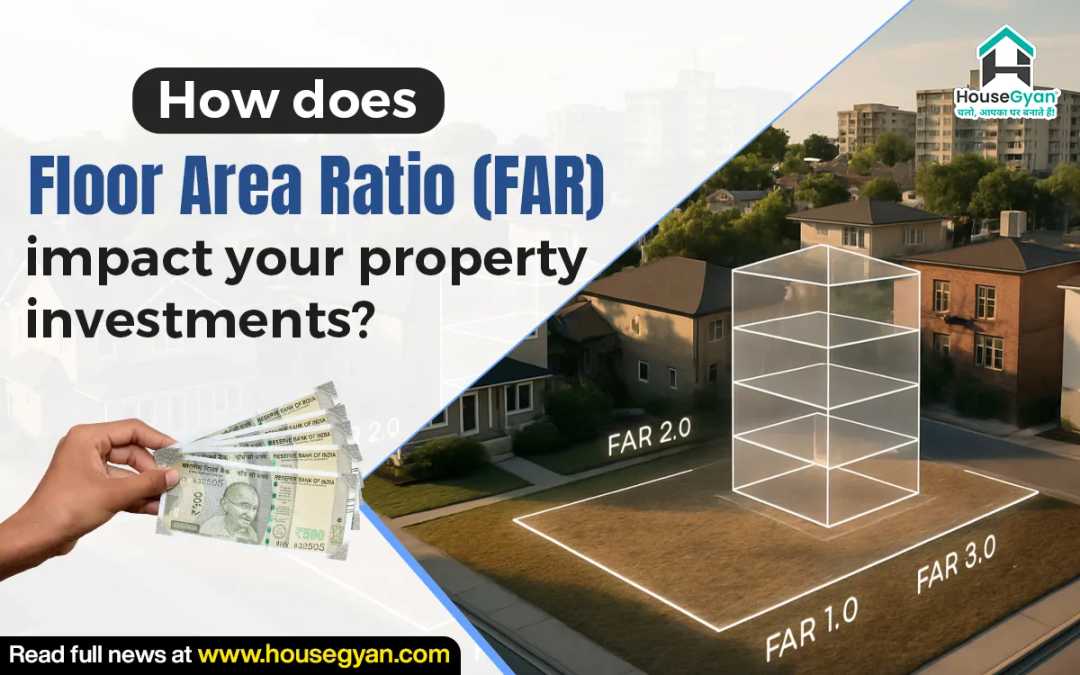
Floor Area Ratio (FAR) refers to the ratio of a building’s total floor area to the size of the land it is built on. In simple terms, FAR tells you how much construction is legally allowed on a specific plot. A higher FAR permits more buildable area, while a lower FAR restricts development.
How FAR Is Calculated
The formula is straightforward:
FAR = Total Building Floor Area ÷ Plot Area
For example, if you own a 10,000 sq ft plot and the FAR is 2.0, you can construct up to 20,000 sq ft of total floor space. The design and shape of that space depend on setbacks, height limits, and local zoning laws.
Why FAR Matters in Real Estate Investment
FAR’s Role in Development Potential
FAR directly shapes how much usable space you can create. More space typically means more units, more rental income, and better overall returns. Understanding allowable FAR can help you identify underdeveloped properties with high potential.
How FAR Affects Property Value
Properties with higher permitted FAR often command premium pricing because they offer greater development flexibility. Investors also tend to prefer properties with redevelopment potential, which makes FAR a decisive valuation factor.
Key Components That Influence FAR
Zoning Regulations
Municipal governments establish FAR limits to manage growth, density, and urban planning. Commercial zones usually allow higher FAR than residential zones.
Plot Size, Setbacks & Height Limits
Even if FAR permits large floor areas, physical constraints like setbacks and height restrictions can limit what you can actually build.
Positive Impacts of FAR on Property Investments
Maximizing Land Use Efficiency
A higher FAR lets developers use land more efficiently, generating more saleable or rentable square footage.
Generating Higher Rental Income
More buildable area often translates to more tenants or units, increasing the overall rental yield and long-term ROI.
Negative Impacts of FAR on Property Investments
Construction Costs & Compliance Issues
Higher FAR projects typically require advanced engineering, leading to increased construction costs.
Overcrowding & Market Saturation Risks
High-density zones can experience oversupply of units, affecting occupancy rates and rental yields.
FAR vs. FSI, Coverage Ratio & Density Regulations
Differences Between FAR & FSI
FSI (Floor Space Index) is essentially the same as FAR; the terms vary by region, but the formula remains identical.
How FAR Differs From Building Coverage Ratio (BCR)
BCR measures the footprint of the building, not the total buildable floor area.
Practical Examples of FAR in Investment Decisions
Low FAR Residential Neighborhood
Low FAR zones preserve quiet, low-density living spaces. They offer long-term stability but limited development potential.
High FAR Commercial Zone
High FAR zones like city centers enable multi-story commercial projects, offering higher returns but increased competition.
How to Evaluate FAR Before Buying Property
Tools and Authorities to Check FAR
Most cities publish zoning maps, FAR tables, and planning guidelines online. Investors should refer to local planning portals or municipal zoning offices for current rules.
Questions Investors Should Ask
What is the current FAR?
Is the area likely to be upzoned?
Are there physical restrictions that override FAR permissions?
What is the market demand for additional units?
Strategies to Leverage FAR for Better ROI
Redevelopment and Upzoning Opportunities
Buying underutilized land in areas expected to receive FAR increases can deliver exceptional value.
Optimizing FAR Through Smart Design
Well-planned structures that maximize vertical space and comply with regulations boost efficiency and profitability.
Common Myths About Floor Area Ratio (FAR)
Myth 1: Higher FAR Always Means Higher Profit
Market demand and construction feasibility also shape profitability.
Myth 2: FAR Is the Only Development Constraint
Height restrictions, coverage ratio, and environmental guidelines also play crucial roles.
FAQs – Floor Area Ratio (FAR) & Property Investments
1. Is FAR the same as density?
No. FAR measures buildable floor area, while density refers to the number of people or units.
2. Does higher FAR always increase property value?
Not always—market conditions and construction limits also matter.
3. Can FAR rules vary between cities?
Yes. Each municipality sets its own zoning laws and FAR standards.
4. How does FAR impact rental income?
Higher FAR often enables more rentable space, improving cash flow.
5. Can FAR be increased for a specific property?
Sometimes—through rezoning, redevelopment applications, or special permissions.
6. Where can investors check FAR guidelines?
Most city planning departments publish FAR tables online. Example: planning resources like Urban Land Institute provide helpful insights.
Conclusion
Understanding how Floor Area Ratio (FAR) impacts your property investments helps you assess development feasibility, predict ROI, and make smarter decisions. Whether you're developing a multi-story commercial complex or evaluating a small residential plot, FAR serves as a foundational metric that influences every stage of planning and investment.
House Gyan all services
Loading...HouseGyan is your trusted platform for everything related to home design, construction, and planning. We offer a complete range of services to help you build your dream home with ease and confidence.
Our Services
- Price Calculators: Plan your budget with our tools like Home Loan EMI Calculator, Tile Price Calculator, Brick Cost Calculator, and more.
- House Drawings & Plans: Explore ready-made house plans or get custom house drawings designed to fit your needs perfectly.
- Elevation Designs: Choose from modern elevation designs or request a custom elevation design for a unique look.
- Accurate Estimates: Get clear and accurate construction cost estimates to plan better.
- Shubh Muhurat & Vastu Tips: Follow our Shubh Muhurat and Vastu guidelines to bring positive energy and harmony to your home.
- DIY Home Repair Guides: Learn easy DIY tips to fix and maintain your home efficiently.
- Interior Design Ideas: Discover creative ideas for living rooms, bedrooms, kitchens, balconies, and more.
Why Choose HouseGyan?
- All-in-One Platform: From house plans to price calculators, we cover it all.
- Custom Solutions: Get personalized designs and estimates for your home.
- Expert Guidance: Access professional tips on Vastu, Shubh Muhurat, and construction materials.
- User-Friendly: Our tools and content are designed to simplify home building for everyone.

The information contained on Housegyan.com is provided for general informational purposes only. While we strive to ensure that the content on our website is accurate and current, we make no warranties or representations of any kind, express or implied, about the completeness, accuracy, reliability, suitability, or availability with respect to the website or the information, products, services, or related graphics contained on the website for any purpose. Housegyan.com will not be liable for any loss or damage including, without limitation, indirect or consequential loss or damage, or any loss or damage whatsoever arising from loss of data or profits arising out of, or in connection with, the use of this website.
Third party logos and marks are registered trademarks of their respective owners. All rights reserved.
By Rapsa Group
 Social Media