

Table Of Content ☰
- Ownership and Land Rights
- Ownership Cost Comparison: Which Is More Affordable?
- Difference Between Flat and Independent House
- Pros and Cons of Buying a Flat
- Pros and Cons of Buying an Independent House
- Life Expectancy Comparison
- Pros and Cons of Buying a Flat vs a House in India
- Pros and Cons of Buying a Flat
- Pros and Cons of Buying an Independent House
- Conclusion: Making an Informed
- FAQs
Homeownership is one of life's largest financial and lifestyle decisions. Every prospective homebuyer in India faces the inevitable question about selecting between a flat and an independent house property.
The differences between a flat vs a house in India include flats offering ease of access and safety, along with jointly shared facilities. In contrast, independent houses offer extensive space and independence, as well as lasting ownership of the land.
In making your selection, you must decide whether to go with a flat or an independent house. House Gyan analyses the key elements involving expense, amenities, privacy features, security options, and resale potential.
Ownership and Land Rights
Buying property in India is one of the biggest decisions of one's life. Deciding between a flat and an independent house relies heavily on ownership considerations.
Independent houses provide homeowners with uncontrolled freedom to redesign their property through personal choices and without being restricted by societal rules or common land conflicts.
Read More: Explore detailed and customizablehouse drawingsfor your dream home
Ownership Cost Comparison: Which Is More Affordable?
People base their final choice on housing options, betweena flat and a house in India, on price considerations.
Multi-unit property systems make flats more affordable for middle-class homebuyers because the cost of land gets spread across all homes located on the same property.
The cost of independent houses remains higher than flats due to the dual purchase of land and construction, which drives the overall investment spending upward. Here’s a comparative distribution of costs:
Difference Between Flat and Independent House
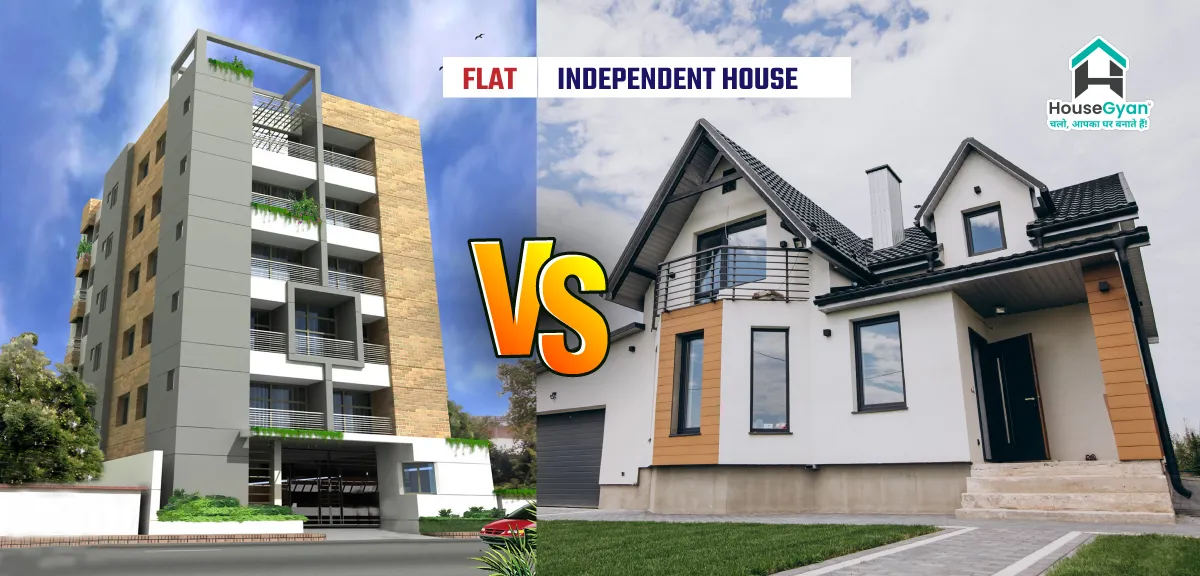
Here is a detailed comparison of a flat vs a house in India based on important criteria:
Read More: Transform the look of your house with expert-crafted front elevation designs that reflect your style.
Life Expectancy Comparison
The sort of ownership it falls under and the quality of construction define the life expectancy of a house.
Pros and Cons of Buying a Flat vs a House in India
Pros and Cons of Buying a Flat
Pros and Cons of Buying an Independent House
Conclusion: Making an Informed
What drives most of you to choose the suitable residence style between a flat vs house in India?
Apart from pricing and security aspects, the current living comfort of apartments makes them a great option that divides maintenance costs. Purchasing an independent property offers long-term personal space benefits as well as improved privacy, coupled with land ownership and customisation options.
How should one decide: which is better, a house or a flat?
Apart from hassle-free living and access to facilities, a flat gives occupants security.
If privacy and long-term investment, coupled with large space, are priorities for you, you should purchase an independent house.
The last say on household decisions will come from personal preferences. What matters most to you—convenience or freedom?
If you need any help in choosing the best accommodation for yourself, contact us right away.
FAQs
1. Which is better: a flat or an independent house in India?
It depends on your needs—flats are better for convenience and security, while independent houses offer more space, privacy, and ownership freedom.
2. Are flats cheaper than independent houses?
Yes, flats are generally more affordable because land costs are shared among multiple owners, whereas independent houses include full land ownership.
3. Which option provides better privacy?
Independent houses provide better privacy since there are no shared walls or common spaces like in flats.
4. Is maintenance easier in flats or houses?
Maintenance is easier in flats as society handles it, while independent houses require self-management.
5. Which has better resale value in India?
Independent houses often have higher appreciation due to land value, but flats also perform well in prime urban locations.
6. Can I modify my property freely in both options?
No, flats have restrictions due to society rules, while independent houses allow complete customization and renovation.
7. Which is safer: a flat or an independent house?
Flats are usually safer because of gated communities and security systems, while independent houses depend on personal security arrangements.