
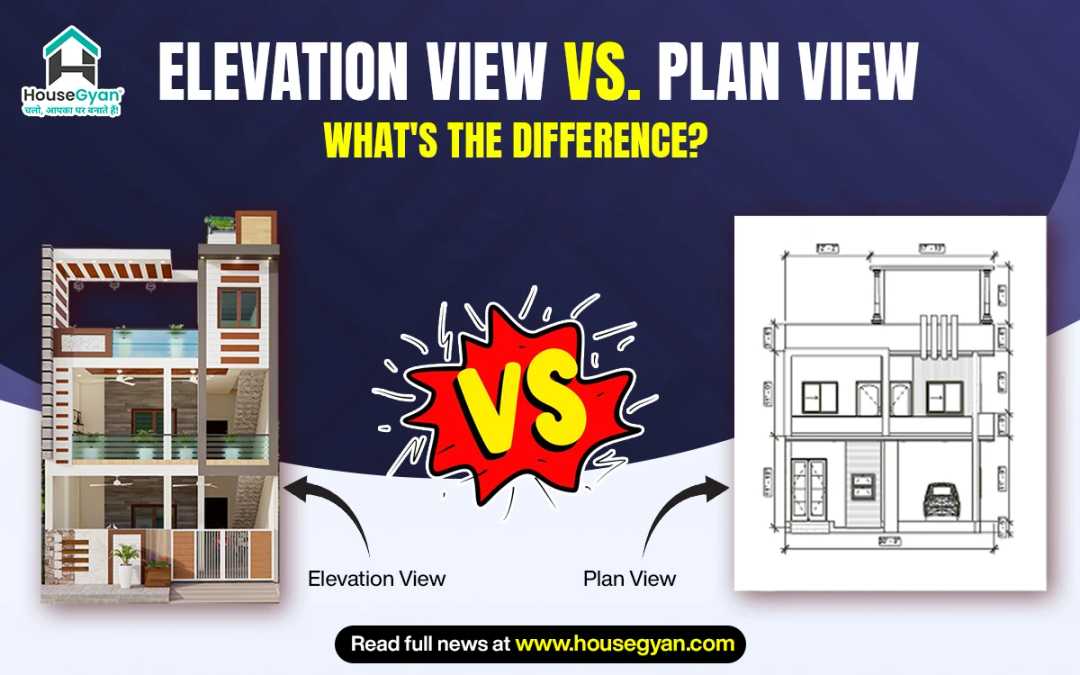
If you are building a house or looking at architectural drawings, you’ll often hear two common terms: Elevation View and Plan View. These are two important types of drawings that help you understand the design of a building.
But what’s the difference between them?
In simple words:
-
Plan View is like looking at your house from the top.
-
Elevation View is like looking at the house from the front or side.
Let’s understand both in detail with examples, uses, and key differences.
What is a Plan View?
A Plan View or house plan is a top-down view of your building—like looking at your home from the sky.
Key Features of Plan View:
-
It shows the layout of rooms, walls, windows, doors, furniture etc.
-
Often called a floor plan or 2D layout.
-
It is drawn to scale so measurements are accurate.
-
Used by architects, engineers, and interior designers.
What You’ll See in a Plan View:
-
Room dimensions
-
Placement of walls
-
Kitchen, bathroom, living room location
-
Staircases, doors, windows
-
Furniture layout (in detailed plans)
Example:
Imagine you remove your house's roof and look down – that’s your plan view.
What is an Elevation View?
An Elevation View or elevation design is a side or front view of the building. It shows how the house will look from outside.
Key Features of Elevation View:
-
Shows the exterior appearance: height, doors, windows, balconies, grills, etc.
-
Can include colors, textures, materials.
-
Can be Front Elevation, Side Elevation, Rear Elevation.
-
Useful for 3D views and designing exterior aesthetics.
What You’ll See in an Elevation View:
-
Height of the building
-
Number of floors
-
Front door, window designs
-
Roof shape, balcony railings, exterior lighting
-
Wall finishes and facade details
Example:
Stand in front of your home and take a photo – that’s the front elevation view.
Elevation View vs. Plan View – Key Differences
|
Feature |
Plan View |
Elevation View |
|
View Angle |
Top-down view |
Front or side view |
|
Shows |
Room layout, wall position, furniture |
Building height, façade, windows |
|
Purpose |
Understanding layout and space usage |
Understanding exterior look and height |
|
Common Use |
Interior design, floor planning |
Front design, building approval |
|
Format |
2D architectural drawing |
2D elevation or 3D rendering |
Why You Need Both Plan and Elevation Views?
If you’re building a house or buying a property, both views are important.
Plan View Helps With:
-
Space planning
-
Furniture layout
-
Interior design
-
Plumbing & electrical layouts
Elevation View Helps With:
-
Getting a clear idea of external design
-
Building approvals and façade design
-
Choosing paint color, tiles, and exterior finish
Types of Elevation Views
-
Front Elevation – The view from the front side of the house
-
Rear Elevation – The back side view of the house
-
Side Elevation (Left/Right) – Views from the left or right
-
Isometric/3D Elevation – A 3D version showing depth and perspective
|
HouseGyan Offering | ||
Which View Comes First in Design?
Usually, architects first create the Plan View to finalize the internal layout. Once the layout is approved, they work on the Elevation Views to show how the house will look from outside.
Frequently Asked Questions (FAQs)
Q1. What is the difference between elevation and plan in construction?
Ans: A plan shows the layout of a building from the top, while an elevation shows the design of the building from the front or side.
Q2. What is a front elevation in a house plan?
Ans: A front elevation shows how the house looks from the front, including doors, windows, balcony, and overall design.
Q3. Is plan view 2D or 3D?
Ans: A plan view is usually 2D and shows the layout of each floor.
Q4. Can I build a house with just a plan view?
Ans: No. You need both plan and elevation views to get a complete design and for construction approval.
Final Thoughts
Whether you're building a new home or redesigning an old one, understanding the difference between plan view and elevation view is essential. These drawings help you visualize the layout and the look of your future home.
With both views in hand, you can make better decisions, save money, and build smarter.
Tip: Always ask your architect for both plan and elevation views before starting construction!